
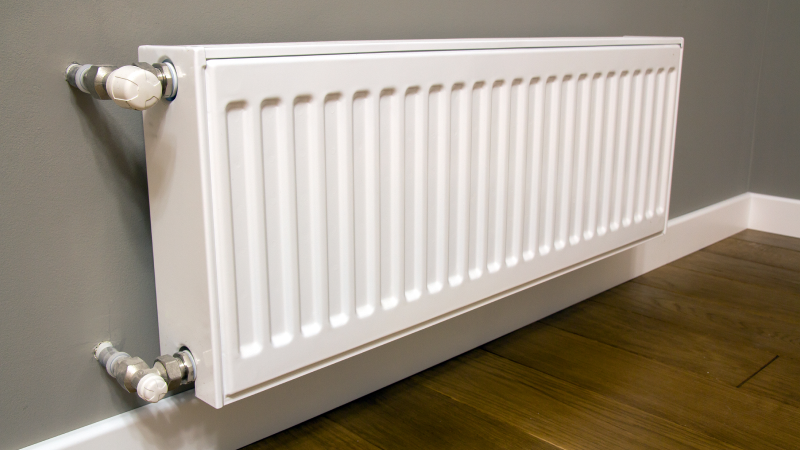
Aluminium is now one of the most widely used materials for household radiators, especially in contexts focused on energy efficiency, light renovations and integration with modern heating systems such as heat pumps.
In this guide we will look at:
- why aluminium radiators are a good choice
- when they are truly advantageous
- how they compare with other materials
- which criteria to evaluate before buying
- common mistakes to avoid when selecting and sizing them
Why choose aluminium radiators?
High thermal conductivity
Aluminium has high thermal conductivity, higher than many other metals used in radiators. This results in:
- fast heating times
- low thermal inertia
- quick response to thermostat commands
In practice, the radiator heats up quickly when the system starts and cools down just as quickly when heating is switched off, allowing more dynamic temperature regulation.
Suitable for low-temperature systems
Aluminium radiators are particularly suitable for systems operating with water temperatures around 45-55 °C, such as heat pumps.
Thanks to their ability to transfer heat quickly into the room, they can provide good performance even with lower flow temperatures compared with traditional high-temperature systems. This makes them compatible with energy-efficient heating configurations.
Lightweight and easy to install
Another advantage is their lower weight compared with cast iron or other heavier materials.
This makes them:
- easier to transport
- simpler to install
- suitable for replacements in apartments without major structural work
Modularity
Aluminium radiators are usually made of modular elements.
This allows you to:
- add or remove sections to adjust heating output
- adapt the radiator if heating demand changes
- customise its length according to the available space
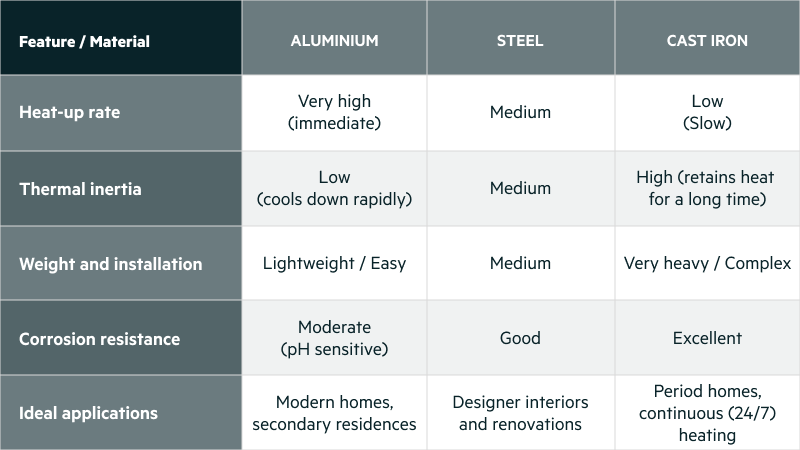
Aluminium vs steel vs cast iron radiators
There is no universally “best” material. The right choice depends on the heating system, building insulation and the type of comfort desired.
- Heating speed. Aluminium heats up the fastest due to its high thermal conductivity. Steel has intermediate heating times. Cast iron is slower but retains heat longer.
- Thermal inertia. Cast iron has high thermal inertia, releasing heat gradually. Aluminium has low thermal inertia, reacting quickly but cooling faster. Steel sits somewhere in between.
- Weight. Aluminium is light and easy to install. Steel has medium weight. Cast iron is very heavy and requires stronger wall supports.
- Compatibility with heat pumps. Aluminium works well with low-temperature systems (45-55 °C) when properly sized. Steel radiators can also perform well if designed for low temperatures. Cast iron is generally less efficient at lower temperatures unless oversized.
- Durability. Cast iron is extremely long-lasting. Steel offers good durability when protected with appropriate treatments. Aluminium requires good manufacturing quality and anti-corrosion treatments to ensure long-term reliability.
How to identify the best aluminium radiators
Not all models are the same. Some technical parameters help evaluate quality.
Heat output per section
Each section should indicate its nominal output (W) for a specific temperature difference (ΔT). It is important to check performance at low ΔT values, not only at ΔT 60 or 50, but also at values compatible with heat pump systems.
Operating pressure
A good aluminium radiator should support operating pressures suitable for domestic systems (typically 6-10 bar). Higher values usually indicate stronger structural design.
Thickness and aluminium quality
The alloy quality and wall thickness influence:
- mechanical resistance
- long-term stability
- reduced risk of micro-leaks
Very light or low-cost models may have thinner walls.
Anti-corrosion treatments
Aluminium may be sensitive to corrosion if the system water is not properly treated.
Check for:
- internal protective treatments
- high-quality external coatings and finishes
- compatibility with mixed systems (copper, steel, etc.)
Certifications and standards
The best aluminium radiators comply with European standards such as EN 442.
Certifications ensure that declared heating output has been tested according to recognised standards and that safety and performance requirements are met.
Best aluminium radiators for heat pumps
When pairing a heat pump with radiators, it is essential to choose models with high thermal output.
Simply replacing the heat generator is not enough: if the heat emitters are not suitable, the system may fail to achieve the desired comfort level or may need to operate at higher temperatures, reducing efficiency.
The principle is simple:larger heat exchange surface = higher output at lower temperatures
With water temperatures around 45-55 °C, typical of heat pumps, the radiator must have sufficient surface area to transfer the required heat to the room.
This may mean:
- more sections
- greater radiator height
- models designed to optimise convection
How much can you save with aluminium radiators?
Savings do not depend solely on the material but on how the radiator interacts with the heating system and control system.
Aluminium radiators offer an indirect efficiency advantage thanks to their responsiveness:
- they heat up quickly
- they reduce the time needed to reach the set temperature
- they react immediately to thermostat adjustments
This can result in shorter heating cycles and more precise control, especially when combined with:
- smart thermostats
- thermostatic valves (traditional or smart)
Actual savings still depend on building insulation, correct sizing and user habits.
Mistakes to avoid when choosing aluminium radiators
- Choosing only based on price. Very cheap models may have thinner walls or lower construction quality.
- Ignoring proper sizing. An undersized radiator will not provide adequate comfort at low temperatures.
- Not checking compatibility with heat pumps. It is important to verify output at ΔT values suitable for low-temperature systems.
- Ignoring design and visual integration. Radiators are visible elements and should fit the interior design.
- Not replacing old valves. Outdated valves may limit regulation and reduce the system’s overall efficiency.
Why consider IRSAP alternatives
IRSAP does not manufacture aluminium radiators but offers high-performance steel radiators designed to operate efficiently with modern and low-temperature heating systems.
Technology and heat output
Radiator performance depends on:
- heat exchange surface
- internal flow design
- correct sizing
IRSAP radiators are developed to ensure adequate performance even with reduced flow temperatures, making them compatible with condensing boilers and heat pumps when properly sized.
Design and customisation
Beyond thermal performance, IRSAP is known for its focus on design and customisation. Its product ranges include:
- tubular radiators
- designer radiators
- models suitable for different architectural contexts
Durability and reliability
Material quality, surface treatments and production controls affect durability.
Steel radiators offer:
- good mechanical resistance
- long-term stability
- compatibility with modern heating systems
Installation and maintenance
When should you replace old radiators?
Replacement is recommended when:
- radiators show corrosion or micro-leaks
- the system is upgraded to low-temperature heating
- improved control or aesthetics are desired
- valves are outdated
Is it necessary to drain the system?
Yes. In most cases it is necessary to:
- drain the system or isolate the relevant circuit
- work on the connections
- restore the correct pressure afterwards
Routine maintenance
To ensure long-term efficiency it is recommended to:
- bleed radiators when needed
- periodically check valves
- verify system pressure
- keep radiator surfaces clean to promote proper heat exchange


