
Which is the better choice between a condensing boiler and a heat pump? There is no single solution that is always better, as the choice depends on several variables. Home insulation, the existing heating system, climate zone, operating temperatures and budget are some of the main factors to consider.
In general, a condensing boiler requires a lower initial investment and can be easier to integrate into traditional heating systems. A heat pump, on the other hand, uses electricity to transfer heat from outside into the home and can offer significant advantages when the building and heating system provide favourable operating conditions.
Let’s therefore look at when it is more convenient to choose a condensing boiler or a heat pump, how these technologies work and which factors to consider when identifying the most suitable solution for your home.
What is the difference between a condensing boiler and a heat pump?
The main difference between a condensing boiler and a heat pump lies in the way the two technologies generate or transfer the heat needed to warm the home.
A condensing boiler generates heat by burning gas. A heat pump, on the other hand, does not generate heat through combustion: it uses electricity to extract thermal energy from an external source, usually the air, and transfer it into the home. This is precisely why it can be particularly efficient when operating at low flow temperatures and in well-insulated buildings.
Both technologies can be used for space heating and, if the system is appropriately configured, for domestic hot water production. Reversible heat pumps can also reverse their operating cycle and contribute to summer cooling.
How does a condensing boiler work?
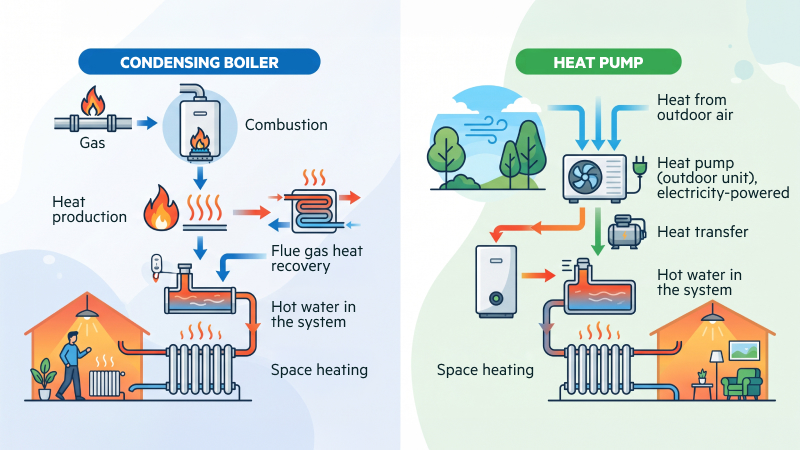
A condensing boiler uses a fuel, usually natural gas, to heat the water supplied to the heating system and, where applicable, to produce domestic hot water.
The main difference compared with a traditional boiler lies in the recovery of some of the heat contained in the combustion gases, which is reused instead of being completely released outside. This improves efficiency and helps reduce energy consumption.
Another advantage is compatibility with many existing heating systems: a condensing boiler can also operate at relatively high flow temperatures, making it generally easier to integrate with existing traditional radiators.
How does a heat pump work?
A heat pump does not generate heat through combustion. Instead, it transfers heat from an external source into the home through a refrigerant circuit powered by electricity.
When comparing heat pumps with boilers, air-to-water heat pumps are particularly relevant. These extract heat from the outside air and transfer it to the water in the heating system. They can therefore supply hydronic systems with radiators, fan coils or radiant heating systems.
Actual performance depends on several factors, including:
-
outdoor temperature;
-
water temperature required by the heating system;
-
correct sizing of the unit;
-
level of building insulation.
In general, a heat pump operates more efficiently when it can work with low flow temperatures and in homes with limited heat loss.
Condensing boiler or heat pump: a direct comparison
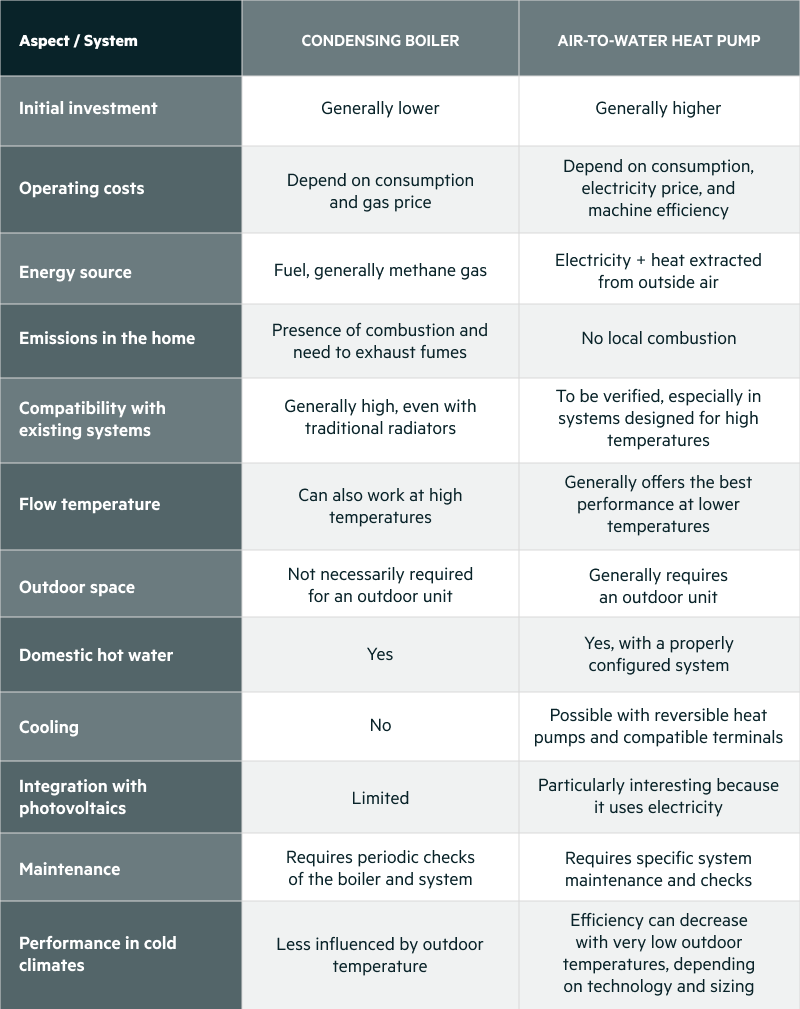
The table provides general guidelines: this does not mean, for example, that a heat pump is always more cost-effective because it uses electricity, or that a boiler is necessarily preferable when old radiators are installed. Actual cost-effectiveness depends on the characteristics of the building, its insulation, climate zone, temperatures required by the heating system, energy costs and usage patterns.
How much do a condensing boiler and a heat pump cost?
When comparing a condensing boiler and a heat pump, the purchase price is only one of the variables to consider. To assess their actual cost-effectiveness, installation costs, any work required on the heating system and operating expenses over the years must also be taken into account.
A condensing boiler generally requires a lower initial investment, especially when replacing an old boiler and when it can be connected to existing radiators and pipework without substantial modifications.
A heat pump often involves a higher initial investment. In addition to the heat generator itself, it may be necessary to modify the heat emitters, electrical system or storage systems or, in some cases, improve the building’s insulation to create more favourable operating conditions.
The comparison, therefore, should not be limited to how much it costs to install the system, but should consider the overall cost over time and the specific characteristics of the home.
Which one consumes less in the long term?
A correctly sized heat pump, installed in a suitable building and used under optimal conditions, can offer low operating costs, particularly when working with low flow temperatures. Combining it with a photovoltaic system can also increase the proportion of self-generated electricity used for heating.
However, there is no single percentage saving that applies to every home. Energy consumption depends on the heat pump’s seasonal efficiency, outdoor temperatures, building insulation, occupants’ habits and electricity costs.
With a condensing boiler, long-term expenditure also varies according to gas prices and the efficiency of the entire system. Condensing technology also performs at its best when operating with sufficiently low return temperatures, a condition supported by low flow temperatures, effective weather compensation and a properly balanced heating system.
When is it worth choosing a heat pump?
Let’s look at some of the scenarios in which this technology can be particularly beneficial.
Heat pumps in new-build homes
In new homes, it is generally easier to create the ideal conditions for a heat pump. New buildings typically have energy-efficient building envelopes, and the heating system can be sized from the outset to operate at low flow temperatures.
This makes it possible to design insulation, the heat pump and heat emitters as a coordinated system, avoiding the adaptations that may be required when upgrading an existing heating system.
Heat pumps with underfloor heating
Underfloor heating is one of the most favourable combinations for a heat pump. Its large heat-emitting surface makes it possible to heat rooms using water at temperatures that are generally lower than those required by many traditional heating systems.
Heat pumps with a photovoltaic system
Combining a heat pump with a photovoltaic system makes it possible to use part of the electricity generated at home to power the heating system.
Cost-effectiveness can increase when energy consumption is managed intelligently, for example by aligning heat pump operation, where possible, with the hours of highest photovoltaic production.
When is a heat pump not worth installing?
A heat pump can be less cost-effective when it is installed without carefully considering the characteristics of the building and the existing heating system. This may be the case, for example, in poorly insulated homes with high heating demand, or in systems with undersized heat emitters that require high water temperatures to maintain a comfortable indoor environment.
The availability of sufficient space for the outdoor unit can also be a constraint, particularly in apartments, apartment buildings or properties subject to specific architectural restrictions.
Climate is another factor to consider. With air-to-water heat pumps, efficiency and available output may decrease as the outdoor temperature falls. This does not mean that the technology is unsuitable for cold climates: some models are designed to operate even at very low outdoor temperatures. However, it is essential to check the unit’s performance under the actual design climate conditions.
Finally, a heat pump may be less attractive when its installation would require particularly invasive work on the heating system, heat emitters or building, resulting in high costs compared with the potential benefits. For this reason, cost-effectiveness should be assessed by considering the entire system rather than the heat generator alone.
When is it worth choosing a condensing boiler?
A condensing boiler can be a sensible solution, particularly when an old heat generator needs to be replaced while retaining most of the existing heating system. It is generally easy to integrate into homes that already have traditional radiators, including when relatively high flow temperatures are required.
It may also be worth considering when the home is already connected to the gas network, the initial budget is more limited and no major energy renovation work is planned.
However, the lower initial investment should not be the only criterion. Long-term operating costs, energy price trends, building characteristics and emission reduction objectives should also be considered.
Condensing boilers in homes with an existing heating system
When replacing an old boiler, being able to retain existing pipework and radiators can simplify the work and reduce the need for invasive modifications.
However, this does not mean that simply connecting the new heat generator to the existing system is enough. It is advisable to check its sizing and balancing and assess whether the flow temperature can be reduced while still maintaining the desired level of comfort. Lower return temperatures allow a condensing boiler to recover more heat from the combustion gases.
When is a condensing boiler not worth it?
A condensing boiler may be less advantageous, for example, in a new building or one with very low energy demand, where a heating system designed to operate at low temperatures can create particularly favourable conditions for using a heat pump.
A heat pump can also be integrated with a photovoltaic system and, if reversible and combined with compatible heat emitters, can contribute to summer cooling. A boiler, by contrast, remains dependent on fuel, resulting in local emissions from combustion, and cannot provide cooling.

Heat pump or boiler with radiators?
Rather than relying solely on the label “low-temperature radiator”, what matters is checking whether the radiator can provide the required heat output at the actual flow and return temperatures of the heating system.
A correctly sized radiator with an adequate heat exchange surface can therefore be compatible with a heat pump even when operating at temperatures below those typically used in traditional heating systems.
To choose the most suitable configuration, it is important to consult the heat outputs declared by the manufacturer under different operating conditions and compare them with the heating requirements of the room.
The IRSAP radiator range includes several solutions designed for low-temperature heating systems and heat pumps, including:
-
HEAT range: includes hydronic radiators such as TESI, as well as product lines such as ARPA, PIANO, SAX and ELLIPSIS, designed to deliver good performance even at lower operating temperatures.
-
RELAX range: models such as Relax Air and Relax Style feature an active ventilation system that helps distribute heat quickly even with low-temperature water. Relax Hybrid also offers summer cooling when installed in a compatible system.
-
IRSAP NOW system: enables smart room-by-room temperature management and coordination between radiators and other heat emitters, helping to optimise heat pump operation.
To make it easier to find a radiator suited to the characteristics of your room and heating system, you can use our configurator, which helps you explore the available models, sizes and configurations.
New home or existing heating system: how does the choice change?
The cost-effectiveness of a condensing boiler and a heat pump varies considerably depending on the starting point. Designing a heating system from scratch allows for different choices compared with replacing the heat generator in an existing home.
Which should you choose for a new home?
In a new-build home, it is generally easier to design a system based on a heat pump. A well-insulated building envelope, low heating demand and heat emitters designed to operate at low temperatures create favourable conditions for heat pump operation.
A heat pump can also be integrated from the outset with photovoltaics and smart control systems, creating a fully electric and coordinated heating system.
Which should you choose when renovating?
When renovating, much depends on the extent of the work. If you plan to improve insulation, replace windows, upgrade heat emitters and renovate the heating system as a whole, it may be the right time to consider switching to a heat pump.
If, on the other hand, the work mainly involves replacing the heat generator while retaining the existing building envelope, pipework and radiators, a condensing boiler may be easier to integrate.
Which should you choose for an older home?
The age of the building alone is not enough to determine which technology is more cost-effective. Even in an older home, it is necessary to assess insulation, windows, heat loss, room heating requirements, flow temperature and radiator sizing.
In a home with significant heat loss, simply replacing the boiler with a heat pump without addressing other aspects may prevent the system from operating under the most efficient conditions.
This does not mean that heat pumps should be ruled out in older homes: improvements to the building envelope or heat emitters can significantly change the initial conditions.
Heat pump and boiler together: when is a hybrid system worthwhile?
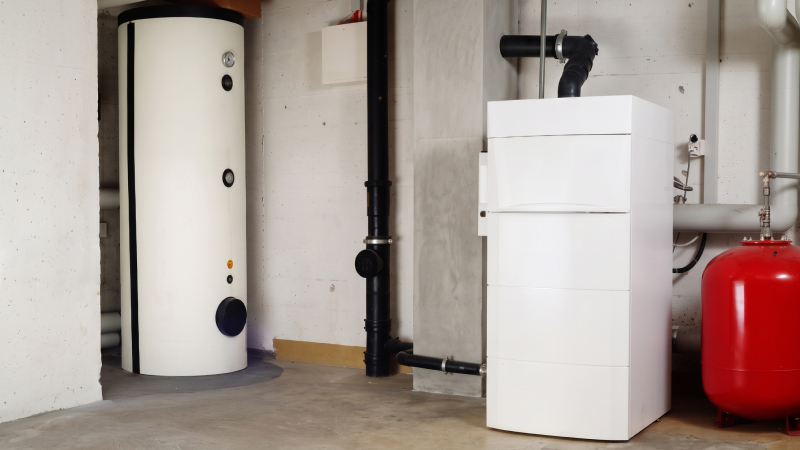
The choice does not necessarily have to be between one technology and the other. A hybrid system combines a heat pump and a boiler, coordinating their operation according to operating conditions.
In general terms, the heat pump can meet heating demand when operating conditions are favourable, while the boiler can take over when higher water temperatures are required or when outdoor conditions make it more appropriate to use the other heat generator. Operation will, however, depend on the control strategy and specific system configuration.
This solution can be particularly interesting for renovations, buildings that require high temperatures during the coldest periods, or situations where the aim is to reduce gas use without immediately replacing the entire existing heating system.
However, a hybrid system is more complex than a system with a single heat generator and requires careful sizing, control and design. It is therefore not automatically the best compromise.
How to choose between a condensing boiler and a heat pump
The first figure to determine is the building’s heating demand, which is closely related to insulation levels, heat loss and climate zone. This determines the required output and the conditions under which the heat generator will need to operate.
Another key factor is the flow temperature required by the heating system. It is therefore necessary to assess the type and sizing of existing radiators and determine whether they can provide the required output even with lower water temperatures, which is particularly favourable for a heat pump.
The assessment should also consider practical and energy-related factors: the presence of a photovoltaic system, available space for an outdoor unit, domestic hot water requirements and whether there is an interest in using the same system for cooling.
Finally, it is necessary to compare the initial investment with estimated operating costs over time. For this reason, the decision should be based on a proper system design and, whenever possible, a simulation of energy consumption under the home’s actual operating conditions, rather than solely on the price of the heat generator.
Frequently asked questions
Which is more cost-effective: a condensing boiler or a heat pump?
It depends on the home. A heat pump can be particularly cost-effective in a well-insulated building with a heating system suitable for low-temperature operation. A condensing boiler may be easier to integrate into an existing heating system that requires higher flow temperatures. The decision should therefore take into account initial and operating costs, building characteristics and system performance.
When is a condensing boiler not worth installing?
It may be less advantageous when designing a new or highly energy-efficient building, where a low-temperature heating system powered by a heat pump and integrated with photovoltaics can be designed from the outset. Dependence on gas and local emissions from combustion should also be taken into consideration.
When is a heat pump not worth installing?
It may be less cost-effective in poorly insulated buildings or in systems that require high water temperatures, especially if upgrading the building envelope and heat emitters would involve significant work. Climate conditions, the space available for the outdoor unit, and the unit’s performance at design temperatures should also be carefully assessed.
Can you use a heat pump with radiators?
Yes. Heat pumps and radiators can be compatible, provided the radiators are sized to deliver the required output at the intended operating temperatures. It is therefore not enough to know that radiators are installed in the home: their heat output at the system’s actual operating temperatures must be checked.
How much can you save with a heat pump compared with a boiler?
There is no single percentage that applies to every home. Savings depend on the heat pump’s seasonal efficiency, building insulation, climate, flow temperatures, gas and electricity prices, usage habits and the possible presence of a photovoltaic system. An energy consumption simulation can provide a more reliable estimate for the individual home.
Can a heat pump also produce domestic hot water?
Yes, a properly configured air-to-water heat pump can be used both for heating and for domestic hot water production, generally through a storage system. Sizing should also take into account the number of occupants and the home’s hot water requirements.


