
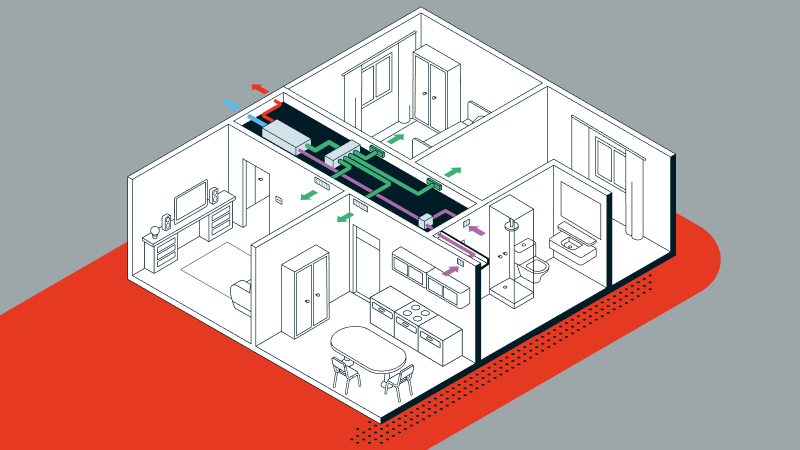
Indoor air quality is becoming an increasingly important factor for everyday wellbeing. In many cases, however, buildings are not yet equipped to ensure effective and constant air exchange. This is where controlled mechanical ventilation comes into play. If you are considering installing a system of this type and want to really understand the different types and their pros and cons, this article is designed to clarify things for you.
What is controlled mechanical ventilation
Controlled mechanical ventilation is a system designed to ensure a constant, continuous and automatic air exchange within rooms.
There are two main types of systems:
- Decentralised systems, consisting of units dedicated to individual rooms;
- Centralised systems, which use a single central unit connected to the various rooms through a network of ducts.
These systems can be single-flow, characterised by separate components for air intake and extraction, or dual-flow, where the same unit provides both air intake and extraction.
How a controlled mechanical ventilation system works
The operation of a controlled mechanical ventilation system is based on a principle shared by all types of systems, regardless of the configuration chosen.
The system extracts stale air from indoor spaces while simultaneously supplying fresh outdoor air, which is richer in oxygen and adequately filtered from pollutants and allergens. This process takes place automatically and continuously, without the need for any manual intervention.
The main advantages of controlled mechanical ventilation
An ideal solution for new builds and renovations
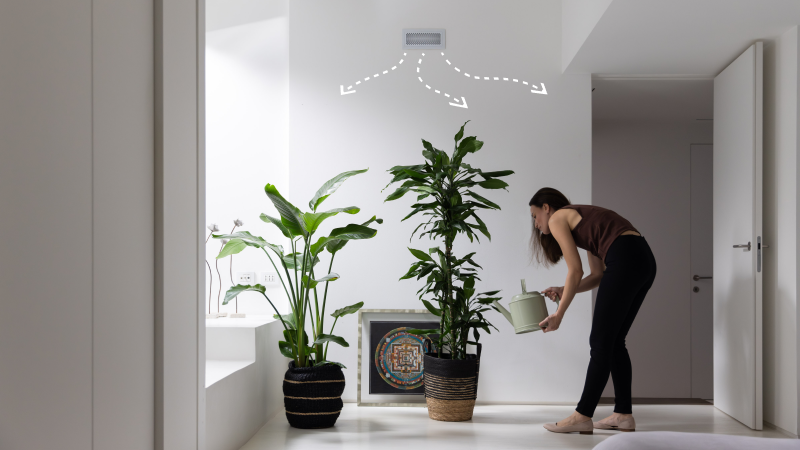
One of the key strengths of controlled mechanical ventilation lies in its ability to adapt to a wide range of residential settings. Whether it is a newly built home, a renovation project, or a building subject to architectural constraints, it is now possible to install an effective and minimally invasive controlled mechanical ventilation system.
In this context, IRSAP’s expertise translates into solutions designed to meet every need: from single rooms to entire homes, as well as apartment blocks and large buildings. IRSAP controlled mechanical ventilation systems are engineered to suit both new constructions and existing properties, including those with heritage or architectural restrictions.
Thanks to the versatility of these systems, the units can be recessed into the false ceiling or installed in a technical room, leaving only discreet air vents visible. Even in buildings with specific constraints, the visual and structural impact remains limited, masonry work is kept to a minimum, and maintenance stays simple and easily accessible.
Improves indoor air quality
In particular, controlled mechanical ventilation helps keep indoor relative humidity under control: humid air is replaced with outdoor air, which is generally drier, preventing prolonged periods of stagnant air and excess humidity, which can lead to surface condensation and mold growth.
Continuous and controlled air exchange
One of the most appreciated benefits of controlled mechanical ventilation is the ability to ensure a constant and controlled air exchange without the need to manually open windows several times a day. In this way, indoor ventilation no longer depends on the occupants’ daily habits but is managed continuously and in a controlled manner by the system itself.
Energy efficiency and living comfort
In dual-flow solutions, thanks to the heat exchanger inside the unit, controlled mechanical ventilation allows air to be renewed without dispersing the heat produced by the air conditioning system. This means maintaining a good level of indoor comfort while avoiding the energy waste associated with traditional ventilation.
The disadvantages of controlled mechanical ventilation
Installation costs
Installing a controlled mechanical ventilation system requires an initial investment, the amount of which can vary significantly depending on the type of system selected and the complexity of the project. In addition to the system itself, masonry work is often required to accommodate the ventilation units and, in the case of ducted systems, the air ducts.
Regular maintenance
Another aspect to consider is system maintenance, which must be carried out regularly to ensure consistent performance over time. This is often perceived as a drawback, but maintenance is actually straightforward and easy to schedule.
Routine system management can be planned without difficulty and does not require complex interventions, turning what might seem like a disadvantage into a manageable and predictable aspect over the long term.
Which controlled mechanical ventilation system to choose
One of the main criteria to consider is the type of property - new build, renovation, or building subject to architectural constraints - as this directly influences the most suitable system configuration, whether centralised or decentralised.
Available space also plays a crucial role. The presence of suspended ceilings, technical rooms or suitable wall surfaces can guide the choice towards solutions that are more or less invasive.
Another key factor is the required level of living comfort, which varies depending on lifestyle, the number of occupants and how the spaces are used. This should be considered alongside product quality, understood not only in terms of performance, but also long-term reliability, ease of operation and simplicity of maintenance.
For this reason, it is essential to rely on solutions specifically designed for the residential sector, capable of responding flexibly and consistently to different needs, such as those offered by IRSAP, which provides controlled mechanical ventilation systems developed to adapt to a wide range of residential and design contexts.

IRSAP solutions for controlled mechanical ventilation
IRSAP’s approach is strongly focused on design flexibility, with solutions that take into account both performance and spatial impact, allowing for discreet integration that remains consistent with the home’s architecture.
Another distinguishing feature is the focus on energy efficiency. IRSAP systems are designed to work in synergy with well-insulated buildings and modern air conditioning systems.
To explore the available solutions in more detail, you can visit the section dedicated to controlled mechanical ventilation, where IRSAP’s residential offerings are presented.
If you have any questions or would like help identifying the system best suited to your needs, you can also request a consultation directly from our experts.
Why choose an IRSAP controlled mechanical ventilation system?
Because when it comes to controlled mechanical ventilation, there is no single solution that works for everyone. What is needed is a system designed around the available space, how the rooms are used and the type of building involved.
IRSAP addresses this complexity by offering controlled mechanical ventilation solutions developed to meet different needs, without requiring users to deal with technical configuration details.
The approach is based on problem solving: systems designed to ensure proper air exchange, energy efficiency and seamless integration into living spaces. The result is effective and reliable ventilation that remains fully consistent with the overall building design, already successfully adopted in private homes and residential developments.
Conclusions: pros and cons of controlled mechanical ventilation
Controlled mechanical ventilation is an increasingly popular solution for improving indoor air quality in residential environments, especially in modern, highly insulated homes.
The main advantages of controlled mechanical ventilation include:
- continuous and controlled air exchange;
- improved living comfort and indoor microclimate;
- greater attention to indoor air quality.
Among the potential drawbacks, it is important to consider:
- the initial investment required for installation;
- the regular maintenance needed to ensure consistent performance over time.
For this reason, choosing a controlled mechanical ventilation system should be based on a careful and informed assessment that takes into account:
- the characteristics of the property;
- the type of project (new build or renovation);
- the actual comfort and indoor air quality requirements.
If you are considering installing controlled mechanical ventilation in your home or as part of a renovation project, gathering thorough information and relying on qualified professional advice is the best way to identify the solution that best suits your needs. Contact our sales network or fill out the form to receive more information.


