
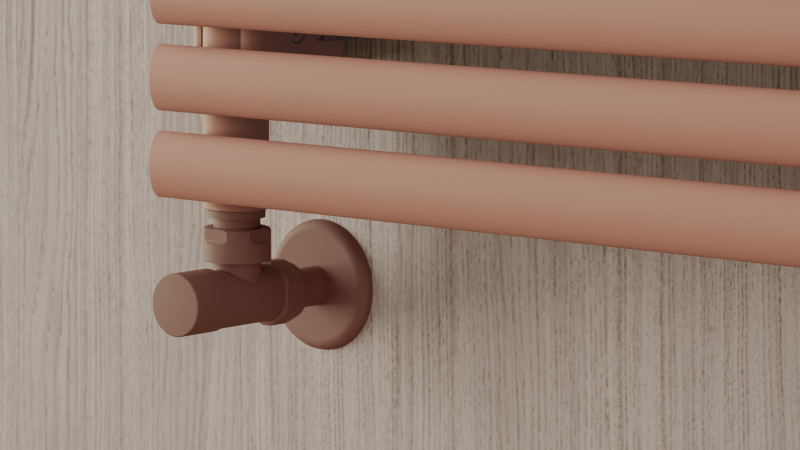
Thermostatic valves are devices that help to control the temperature in domestic spaces. When selected and used correctly, thermostatic valves help optimise the efficiency of the heating system and reduce overall energy consumption.
Thermostatic valves: what they are and what they are used for
Thermostatic valves are devices installed on radiators that automatically regulate the flow of hot water based on the room temperature.
Thermostatic valves perform several essential functions:
- Personalised heat control. Each radiator can operate independently, allowing different temperatures to be set in different rooms according to how the spaces are used.
- Reduced energy consumption. By preventing rooms from overheating and modulating heat output only when needed, thermostatic valves help lower energy use and reduce heating bills.
How traditional thermostatic valves work
Traditional thermostatic valves are mechanical, manually operated devices. Their operation is simple and intuitive:
- regulation is carried out via a control knob connected to the valve;
- the knob, also known as the thermostatic head, usually features a graduated scale with values ranging from 0 to 5;
- by turning the knob, the flow of hot water through the radiator is increased or reduced.
How electronic thermostatic valves work
Electronic thermostatic valves perform the same basic function as traditional valves, but use next-generation electronic controls to achieve more precise temperature management.
The main difference lies in temperature control:
- adjustment is no longer done manually on the knob;
- the temperature can be set and managed remotely, often via a smartphone or dedicated control systems.
Thanks to these features, electronic thermostatic valves help prevent radiators from overheating or underheating a room. The result is improved comfort control and, in many cases, reduced energy consumption.
How Wi-Fi thermostatic valves work
Wi-Fi thermostatic valves are an advanced type of valve that allow heating to be managed via an app, using a wireless connection.
Operation is straightforward: through a smartphone app, the desired temperature can be set for each room. A built-in sensor detects the actual room temperature, and the valve automatically opens or closes to keep it stable. This makes it possible to achieve personalised, room-by-room heat control, even remotely.
Today, several Wi-Fi thermostatic valve solutions are available for residential use, such as IRSAP smart valves, which allow you to control the temperature wherever and whenever you want via the IRSAP NOW app.
How to install and adjust thermostatic valves
Thermostatic valves are installed directly on radiators and, in most cases, do not require invasive work. Traditional thermostatic heads are mounted onto the radiator valve body, while more advanced versions simply replace manual heads, with no need for masonry work or wiring.
In centralised heating systems, installation must be carried out by a qualified technician to ensure correct system operation and compliance with current regulations.
Adjustment of thermostatic valves is based on the desired temperature for each room, using the numerical scale, generally from 0 to 5 (a more detailed explanation is provided in the next section).
Operation is controlled by a thermostatic sensor, an internal heat-sensitive component that reacts to temperature changes:
- if the room temperature exceeds the set value, the sensor expands and reduces the flow of hot water;
- if the temperature drops, the sensor contracts and allows a greater flow of water into the radiator.
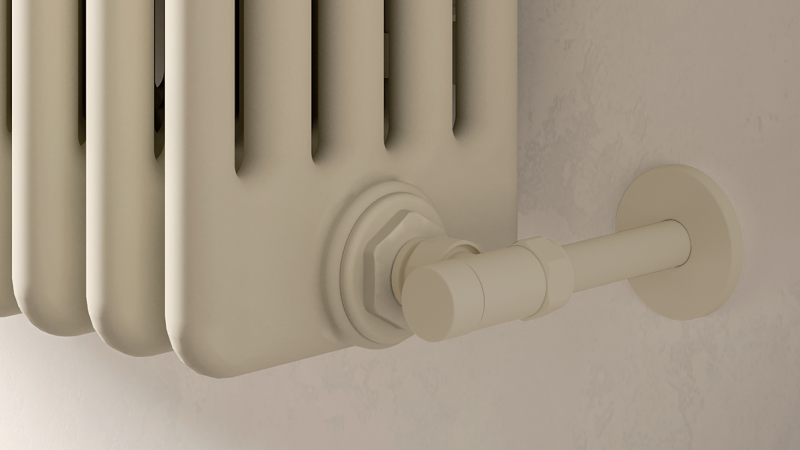
What do the numbers on thermostatic valves correspond to?
Thermostatic valves feature a numerical scale, usually ranging from 0 to 5, which allows different temperature levels to be set within a room.
Level 0 - Frost protection
This setting keeps the temperature at very low values, generally around 5-6°C. It is designed to protect the heating system from freezing when a room is not used for long periods.
Level 1 - Cool environment
Level 1 corresponds to an indicative temperature between 12°C and 16°C. It is suitable for infrequently used rooms or spaces that do not require constant heating.
Level 2 - Moderate heating
At level 2, the temperature typically ranges between 16°C and 18°C. This is a good option for secondary rooms or for nighttime use, when a lower temperature is often preferred.
Level 3 - Standard comfort
Level 3 is considered the reference setting and corresponds to approximately 19-21°C. It is ideal for living areas such as the living room and dining room and is close to the recommended comfort temperature of around 20°C.
Level 4 - High comfort
With level 4, the temperature can reach values between 21°C and 23°C. This setting is suitable for rooms where a greater sense of warmth is desired, such as bathrooms.
Level 5 - Maximum heating
Level 5 represents the highest setting, with temperatures that can reach 23-25°C or higher. It is useful for quickly heating up a very cold room, but it is not recommended as a permanent setting, as it increases energy consumption and can make the air drier.
How to bleed radiators with a thermostatic valve
Bleeding radiators is a simple but essential operation to ensure the correct functioning of the heating system. When air builds up inside radiators, heat is distributed unevenly, rooms become less comfortable and energy consumption tends to increase.
Radiators fitted with thermostatic valves should be bled with the heating system switched off. In individual systems, it is sufficient to turn off the boiler or heat pump and wait until the radiators are cold; in centralised systems, the procedure should be carried out during scheduled system shutdown periods.
To bleed a radiator correctly, it is advisable to set the thermostatic valve to its fully open position, in order to facilitate the release of trapped air.
Only a few tools are needed to bleed a radiator with a thermostatic valve:
- a bucket to collect any water;
- a cloth or rag to protect walls and floors;
- a bleed key, usually supplied with the radiator or easy to obtain.
Once the bleed valve has been located, it is enough to open it slowly until air stops escaping and only water begins to flow out. At this point, the valve can be closed again and the thermostatic head reset to the desired setting.
Thermostatic valve maintenance
Maintaining thermostatic valves is straightforward and involves just a few essential operations, aimed at ensuring proper long-term performance and preventing blockages or inefficiencies, especially between one heating season and the next.
During everyday use, thermostatic valves do not require complex interventions. It is sufficient to:
- check that adjustment remains smooth and responsive;
- take action if radiators heat unevenly, bleeding them if necessary;
- pay attention to boiler pressure, which must remain within the correct range to ensure efficient system operation.
For external cleaning of valves and radiators, it is recommended to use only soft cloths, avoiding aggressive detergents or chemical products that could damage surfaces or internal mechanisms.
At the end of the heating season, it is good practice to take a few precautions to prevent issues when the system is restarted:
- Set all thermostatic heads to the maximum value (5). This helps prevent limescale build-up and possible seizing of the internal pin during periods of inactivity.
- Check for and remove any air trapped in the radiators. If necessary, bleeding the radiators helps keep the system in optimal condition.
How to save energy by using thermostatic valves correctly
Set the optimal temperature
Proper adjustment starts with choosing reasonable temperature levels:
- 19-20°C in living areas;
- 18-19°C in bedrooms.
Each degree less can result in estimated energy savings of around 6-7%, without compromising comfort.
Avoid excessive settings
Turning the knob to the maximum level does not heat a room more quickly. On the contrary, it only increases energy consumption, without delivering real comfort benefits.
Set all valves in the same room evenly
To achieve uniform heating, it is important to set all thermostatic valves in the same room to the same level. This prevents some radiators from working harder than necessary and improves overall efficiency.
Manage rarely used rooms properly
In rooms that are used infrequently, it is advisable to lower the valve setting, but without closing it completely.
Do not cover radiators
Covers, curtains or furniture placed in front of radiators hinder heat distribution and distort temperature readings, forcing the valve to work harder than necessary.
Ventilate correctly
During air exchange, it is good practice to:
- temporarily lower the valve settings;
- ventilate for just a few minutes, avoiding leaving windows open for extended periods.
Limit heat loss
To further improve the effectiveness of thermostatic valves, it is also useful to reduce heat loss by:
- sealing any draughts;
- closing shutters or blinds in the evening and at night.


