
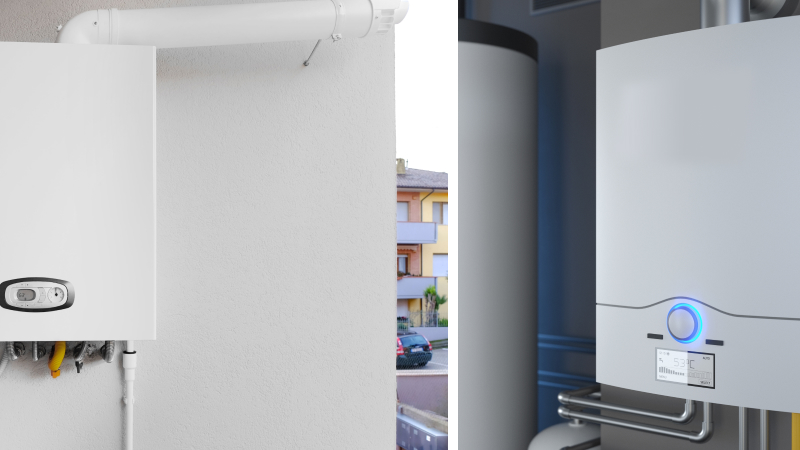
Installing a boiler inside the home is possible, but only if specific technical and regulatory requirements are met. The choice of installation location, in fact, does not depend only on the space available, but also on factors such as the type of appliance, room ventilation, flue gas discharge and the safety conditions required by regulations.
Those who need to install or replace a boiler often face a common question: is an indoor or outdoor boiler better? The answer depends on several aspects, including the characteristics of the home, the type of system and the applicable technical requirements.
In this guide, we will look at what the regulations say, which rooms are generally suitable or should be avoided, the differences between open-flue and sealed-chamber boilers, also known as condensing boilers, and which elements to assess before choosing the most suitable installation.
Boiler inside the home: what the regulations say
The installation of a domestic boiler is regulated by a series of technical standards and legislative provisions designed to ensure the safety of occupants, correct flue gas evacuation, adequate room ventilation and proper system maintenance.
The main regulatory references include:
-
UNI 7129, a fundamental reference for the design and installation of domestic gas systems with a power output of up to 35 kW. Among other aspects, it defines the requirements relating to installation rooms, ventilation and systems for discharging combustion products.
-
Ministerial Decree 37/2008, which regulates the installation of systems inside buildings and establishes the obligations relating to the declaration of conformity issued by the installer.
-
Presidential Decree 74/2013, which regulates the operation, management, inspection, maintenance and checks of heating systems.
It is important to remember that these provisions may be supplemented by local regulations, the manufacturer’s specific instructions and the assessments of the professional responsible for installation.
For this reason, the information provided in this guide is for general guidance only and does not replace an inspection and design assessment by a qualified technician, who must verify the compliance of the system in the specific case.
Can a boiler be installed inside the home?
Yes, in most cases it is possible to install a boiler inside the home, provided that the conditions required by regulations are met.
Today, indoor installation mainly concerns condensing boilers and sealed-chamber appliances, type C, which guarantee higher safety standards than older open-flue models.
The possibility of installation depends on several factors, including:
-
type and power output of the boiler;
-
intended use of the room;
-
presence of adequate aeration or ventilation;
-
correct flue gas discharge system;
-
accessibility for maintenance and checks;
-
compliance with distances and safety requirements.
For this reason, it is not possible to establish in advance whether a boiler can be installed in any domestic environment: each situation must be assessed case by case.
Condensing and sealed-chamber boilers: why they are more suitable indoors
Condensing boilers and sealed-chamber appliances, type C, are generally the most suitable solutions for indoor installation.
The reason is simple: the combustion circuit is separate from the domestic environment. The air required for combustion is taken from outside and the fumes are expelled through dedicated discharge systems, reducing the risks associated with combustion inside the home.
This does not mean that they can be installed anywhere. These appliances must also comply with the requirements relating to the room, flue gas discharge and installation methods set out by regulations and by the manufacturer.
For this reason, the solution must always be assessed by a qualified technician.
Open-flue boilers: what are the limitations?
Open-flue boilers, also known as type B appliances, work differently: they take the air required for combustion directly from the room in which they are installed.
Precisely because of this characteristic, they are subject to much stricter requirements and cannot be installed in certain rooms, such as bathrooms and bedrooms, for safety reasons.
In existing buildings, it is still possible to find boilers of this type, but in the event of replacement it is advisable to carefully assess the situation with a professional, especially in the presence of shared flues, condominium systems or specific technical constraints.
In most cases, modern sealed-chamber condensing boilers are now the solution most in line with current safety and energy efficiency standards.
Where a boiler can be installed inside the home
The choice of the room in which to install a boiler inside the home depends on the type of appliance and the characteristics of the space.
In general, a boiler can be placed in the kitchen, storage room, technical room, laundry room or other suitable indoor spaces, provided that the requirements for safety, aeration or ventilation, flue gas discharge and accessibility for maintenance and checks are met.
The position should not be chosen only for convenience or aesthetic reasons. It is also necessary to check:
-
free space around the appliance;
-
minimum distances indicated by the manufacturer;
-
possibility of easy access for maintenance;
-
correct connection to the flue gas discharge system;
-
suitability of the room in relation to the type of boiler.
Boiler in the kitchen
The kitchen is one of the rooms where boilers are most often installed, especially in apartments.
However, the presence of other gas appliances, such as the hob, makes it essential to check correct aeration, ventilation and flue gas evacuation.
A condensing or sealed-chamber boiler can be installed in the kitchen if the room and the system comply with the required conditions. If it is placed inside a cabinet or niche, sufficient space, accessibility and correct ventilation must be guaranteed.
Boiler in a storage room or technical room
Storage rooms, technical rooms or dedicated spaces can be suitable solutions, but only if they are technically appropriate.
Having free space is not enough: the room must allow the appliance to operate correctly, provide any required air exchange, ensure flue gas discharge and allow access for periodic checks.
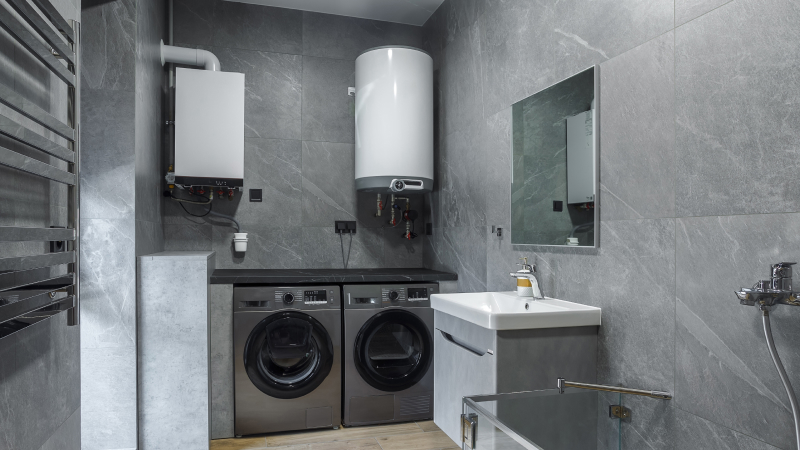
Boiler in a laundry room or utility room
A laundry room or utility room can be a practical choice, especially if it is already prepared for systems, drains and technical connections.
These rooms often make it possible to avoid having the boiler visible in the kitchen or bathroom, but they must still be designed correctly, respecting ventilation, accessibility and safety requirements.
Boiler in the bathroom
Installing a boiler in the bathroom must be assessed with particular care and depends on the type of appliance.
Open-flue boilers are not allowed in bathrooms, because they take the air required for combustion directly from the room. Sealed-chamber or condensing boilers, on the other hand, may be installed if the project complies with technical requirements, correct flue gas discharge and safety distances.
Where a boiler cannot be installed inside the home
There are rooms where boiler installation is prohibited or strongly discouraged for safety reasons.
The issue mainly concerns the risk of incorrect combustion, gas accumulation, poor ventilation or difficulty evacuating fumes.
Boiler in the bedroom
The bedroom is not a suitable room for installing appliances that may involve risks related to combustion or environmental safety.
In particular, open-flue boilers must not be installed in rooms intended for sleeping.
Boiler in the garage
The garage is a space that must be assessed very carefully, because it may present risks related to the presence of fuels, vapours, poor ventilation or uses that are not compatible with the installation of gas appliances.
The installation must always be inspected by a certified technician.
Windowless rooms, cabinets and closed spaces without aeration
Windowless rooms, closed cabinets or spaces without aeration are not suitable if they do not allow correct air exchange, access to the boiler and compliance with minimum distances.
Concealing the boiler must never compromise safety, ventilation and maintenance.
Boiler inside a cabinet or cupboard: is it allowed?
Many people choose to conceal the boiler inside a cabinet in the kitchen, bathroom or storage room to reduce its visual impact. This solution may be possible, but it is not always allowed and must comply with precise technical conditions.
The possibility of installing a boiler inside a cabinet depends on several factors:
-
type of boiler;
-
manufacturer’s instructions;
-
minimum safety distances;
-
correct aeration or ventilation;
-
accessibility for maintenance and checks.
For aesthetic reasons, there are also boiler covers and concealed solutions specifically designed for this use. However, it is essential that they do not obstruct the correct operation of the appliance or prevent maintenance operations.
The free space around the boiler is also an aspect that should not be underestimated: the minimum distances must always be checked in the product technical data sheet and confirmed by the installation technician.
Aeration and ventilation of the boiler room: what to know
When installing a gas boiler inside the home, it is important to distinguish between aeration and ventilation, two concepts that are often confused but have different functions.
Aeration concerns the exchange of air between the room and the outside, while ventilation is linked to the air supply required for combustion and system safety.
Requirements change according to the type of appliance installed:
-
sealed-chamber and condensing boilers have a combustion circuit that is separate from the room and generally require fewer constraints in this respect;
-
open-flue boilers, on the other hand, use the air in the room for combustion and require greater attention to ventilation requirements.
When ventilation grilles or openings are needed
In some cases, regulations require permanent openings to the outside or adequate ventilation systems.
The characteristics of these openings depend on several factors, including:
-
boiler power output;
-
type of appliance;
-
characteristics of the room.
Aeration grilles play a fundamental safety role and must never be covered, closed or obstructed, because they ensure the correct air supply required by the system.
What changes between open-flue and sealed-chamber boilers
The main difference concerns the way combustion takes place.
Open-flue boilers, type B, take air directly from the room in which they are installed, which is why they are subject to stricter constraints.
Sealed-chamber boilers, type C, instead use a separate combustion circuit and draw air from outside. This characteristic allows for greater safety and generally makes these appliances more suitable for indoor installations, always in compliance with the applicable technical requirements.
Flue gas discharge for boilers inside the home: general rules
One of the most important aspects of installation concerns correct flue gas discharge.
In general, combustion products must be evacuated through chimneys, flues or systems that comply with current regulations.
Wall discharge is allowed only in specific situations provided for by regulations and must comply with precise technical conditions, including safety distances from windows, balconies and openings.
For condensing boilers, it is also necessary to provide correct condensate drainage, which must be managed according to the manufacturer’s instructions and regulations.
Roof discharge, wall discharge and flue
The most suitable solution depends on the type of building, the existing system and the characteristics of the boiler.
In many cases, discharge takes place through a flue or evacuation system that conveys fumes up to the roof. Wall discharge is possible only when the conditions required by regulations are met and after verifying compliance with the applicable technical requirements.
For this reason, the choice of discharge system must always be assessed by a qualified technician.
Boiler in an apartment building: what to check
In condominium buildings, particular attention must be paid to the presence of shared flues, condominium regulations and constraints relating to the building façade.
It is not always possible to freely choose the route of the flue gas discharge system, so it is essential to check in advance the compatibility of the intervention with the existing system and with the applicable provisions.
Indoor or outdoor boiler: advantages and disadvantages
Once you have checked what the regulations allow, you can assess which solution best meets your needs.
The choice between an indoor and outdoor boiler does not depend only on the space available, but also on aspects such as practicality, maintenance, exposure to weather conditions and the characteristics of the home.
Advantages of an indoor boiler
A boiler installed indoors is better protected from rain, frost, wind and temperature changes, conditions that can help preserve its correct operation over time.
It may also be easier to access for checks and maintenance and, if correctly placed inside a niche or technical cabinet, it can be integrated into the room while limiting its visual impact.
In some apartments or condominium buildings, it is also the most practical solution, because it avoids work on the façade or balcony.
Disadvantages of an indoor boiler
Indoor installation requires a suitable, accessible space that complies with the requirements set out by regulations.
In addition to overall dimensions and visual impact, it is necessary to ensure compliance with the requirements relating to aeration, ventilation, flue gas discharge and maintenance.
The main limitation is therefore not only the space occupied, but the need to comply with precise technical and safety requirements.
Advantages of an outdoor boiler
Installing the boiler outdoors frees up space inside the home and can be an interesting solution when you do not want to occupy the kitchen, bathroom or storage room.
If the technical conditions allow it, it can be positioned on balconies, terraces or external walls, helping to keep indoor spaces tidier.
Disadvantages of an outdoor boiler
A boiler installed outdoors is more exposed to rain, frost, wind, dust and temperature changes. For this reason, it must be designed for this type of use or adequately protected.
In condominium buildings, there may also be limitations relating to the architectural appearance of the façade or internal regulations, aspects that should be checked before installation.
Where to position an outdoor boiler
If you choose to install a boiler outdoors, it is important to identify a position that guarantees safety, practicality and ease of maintenance.
The most common locations are:
-
balcony or terrace;
-
external wall of the home;
-
external technical compartment.
In all cases, the boiler must be installed in a point that is easily accessible for checks and maintenance work, as well as allowing correct connection to the hydraulic and electrical systems and to the flue gas discharge system.
The choice of position must always comply with the manufacturer’s instructions, current regulations and, in condominium buildings, any rules relating to the appearance of the façade or shared areas.
How to protect an outdoor boiler
A boiler installed outdoors is more exposed to weather conditions. For this reason, it is important to protect it from rain, wind, frost and direct sunlight, especially in colder climate zones.
Depending on the model, it is possible to use:
-
boiler covers;
-
protective boxes;
-
specific technical cabinets.
However, these solutions must be compatible with the boiler and must not compromise the correct operation of the appliance. In particular, they must not obstruct ventilation, flue gas discharge, access for maintenance or the minimum distances required by the manufacturer.
Mandatory documents after boiler installation
After installing the boiler, it is important to keep all documentation certifying the compliance and correct management of the system.
The main documents include:
-
Declaration of Conformity, issued by the installer pursuant to Ministerial Decree 37/2008, certifying that the system has been installed in accordance with current regulations.
-
System booklet, a document that records the characteristics of the system and the interventions carried out over time.
-
Inspection and maintenance reports, including those relating to energy efficiency as required by Presidential Decree 74/2013.
Keeping these documents is essential both to demonstrate that the system is compliant and to correctly plan subsequent maintenance and inspection activities.
When to contact a technician
The regulations relating to boiler installation should not be interpreted independently, because each system has specific characteristics.
The choice of the most suitable solution depends on numerous factors, including:
-
type of boiler;
-
power output of the appliance;
-
characteristics of the room;
-
flue gas discharge system;
-
ventilation;
-
condition of the existing system;
-
any local or condominium regulations.
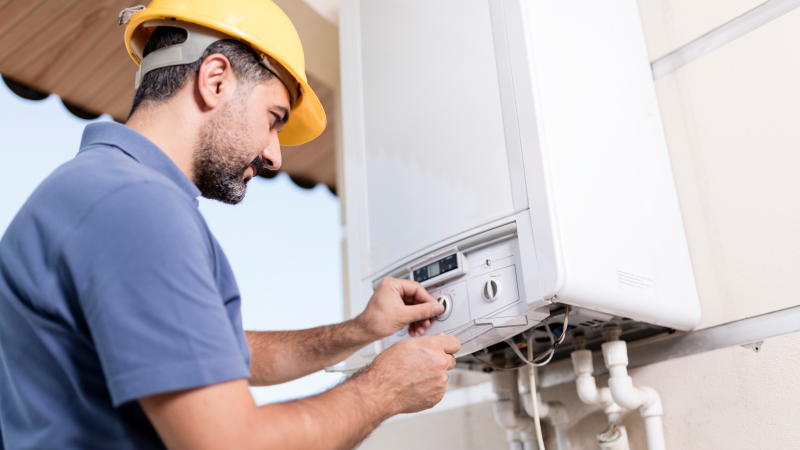
For this reason, it is always advisable to rely on a qualified technician, who can verify the feasibility of the intervention, carry out the installation in compliance with regulations and issue all the required documentation.
IRSAP solutions for heating comfort and control
Correct boiler installation is only one of the aspects that contribute to the efficiency of the heating system.
To achieve greater comfort, more controlled consumption and better temperature management, it is also important to consider the other components of the system, such as radiators, heated towel rails and smart regulation systems.
IRSAP solutions make it possible to design a complete heating system that combines performance, design and intelligent temperature control in domestic environments.
To explore the topic in more detail, you can consult:
-
IRSAP NOW - smart heating control system


