
During winter, is it better to leave the heating on all the time or turn it off when you leave the house? It’s a very common question, especially when trying to reduce energy consumption without coming home to a cold house.
In reality, there is no single rule that applies to every home. The most cost-effective strategy depends on the building’s insulation, the type of heating system, the heat generator used, how long you are away from home and the temperatures you set.
Rather than simply choosing between “on” and “off”, it is therefore important to understand how to manage your heating based on the characteristics of your home and your daily habits.
Is it better to leave the heating on all the time or only turn it on when needed?
From an energy perspective, lowering the indoor temperature reduces heat loss to the outside. For this reason, it is not correct to assume that leaving the heating on all the time will necessarily save energy compared with turning it off.
At the same time, however, constantly switching the heating off and back on can be impractical and uncomfortable, especially when you are only away for a short time. If the home cools down significantly, when you return you will have to wait not only for the air, but also for the walls, floors and furniture to return to a comfortable temperature.
The most suitable solution therefore depends on the thermal behaviour of the building. In a well-insulated home that is occupied every day, it may be useful to lower the temperature while you are away rather than constantly adjusting the system. For longer periods away, a more significant temperature reduction or switching the heating off may make more sense, provided that the risk of freezing and the characteristics of the property are taken into account.
Should you leave your boiler on all the time?
When people talk about “leaving the boiler on all the time”, they often actually mean leaving the heating system active for many hours. However, these are two different things.
A modern boiler does not necessarily produce heat continuously simply because the heating system is switched on. Depending on the model and control system, the heat generator can modulate its output or stop operating once the required temperature has been reached, then restart when necessary.
As a result, keeping the heating system active does not necessarily mean that the boiler is constantly operating at maximum power.
Good temperature control allows the system to adjust heat output according to the actual needs of the home, avoiding both excessive temperatures and the need to continuously adjust the thermostat manually.
The answer depends on your home and heating system
The thermal behaviour of a building has a significant impact on the most effective heating strategy.
A well-insulated home loses heat more slowly and maintains the temperature it has reached for longer. By contrast, in a building with limited insulation, poorly performing windows or numerous thermal bridges, the temperature may drop more quickly once the heating is switched off.
How the property is used also matters. A home occupied every day has very different requirements from a second home used only at weekends.
The type of heat generator and heating system must also be considered. A condensing boiler, heat pump and conventional boiler operate according to different principles and under different conditions. Heat pumps, for example, can benefit in many systems from more continuous operation at lower flow temperatures. With any system, however, the right strategy should also take into account the heat emitters, controls and characteristics of the building.
When is it better to leave the heating on?
Rather than leaving the heating “on all the time” at the same temperature, in some situations it may be useful to keep the system active while lowering the setpoint during periods when less heat is required.
This strategy may be worth considering when you are only leaving the house for a few hours, when the property is occupied every day, or with heating systems that operate efficiently when relatively stable conditions are maintained.
It may also be useful in buildings with good thermal inertia, where walls and other structural elements retain accumulated heat for longer.
The main benefit is related to comfort: when you return, the house is not starting from a very low temperature and can more easily reach the desired conditions. However, this does not mean that maintaining a high temperature throughout the entire period you are away will save energy. When full comfort is not required, lowering the temperature generally helps reduce heat loss.
When is it better to turn the heating off?
The longer you are away, the less sense it makes to keep your home at the same temperature you would use while it is occupied.
During a weekend away or a holiday, for example, it is generally advisable to set a lower temperature or, where conditions allow, switch the heating off. The right choice will nevertheless depend on the climate, the building and the heating system: during particularly cold periods, it may be necessary to maintain a minimum temperature or activate frost protection.
Heating schedules can be particularly useful in these situations, as they allow rooms to gradually return to the desired temperature before you get home, without unnecessarily maintaining full comfort throughout the entire period you are away.
The most common mistakes that really increase energy consumption
Inefficient heating management is not only about how many hours the system is switched on. Certain habits can have a significant impact on both energy consumption and comfort.
One of the most common mistakes is setting the temperature too high, in the belief that this will heat the home more quickly. The setpoint indicates the temperature you want to reach, and increasing it beyond what is necessary is generally not an effective way to heat the home faster.
Constantly changing the settings can also make it more difficult to manage the heating system efficiently. It is better to establish temperatures and schedules that reflect your daily routine, differentiating them according to how individual rooms are used whenever possible.
Finally, heating system maintenance and the correct operation of radiators and control systems should not be overlooked. An efficient, properly regulated system is essential for using energy more responsibly.
How to find the right balance between comfort and energy savings
The goal should not be to keep the heating switched on for as little time as possible, but rather to provide heat when and where it is needed and reduce it at other times.
Heating schedules can, for example, maintain a comfortable temperature in the morning and evening, lower it during working hours and adapt it to the different requirements of living and sleeping areas.
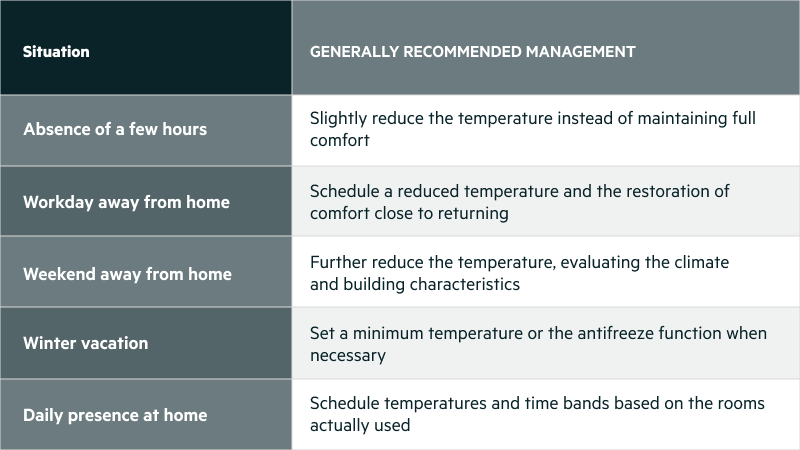
As a general guideline, heating can be managed as follows:
How to manage your heating intelligently with IRSAP NOW
Managing your heating does not have to mean constantly switching it on and off or manually changing the settings. A smart control system makes it easier to adapt heating operation to your daily routine.
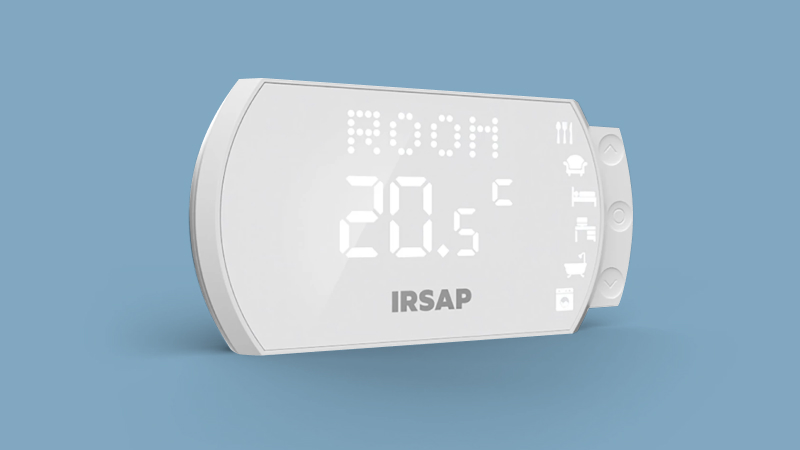
IRSAP NOW allows you to manage home comfort through the App, scheduling temperatures and times and controlling the system remotely. The Home/Away mode allows heating management to adapt according to whether you are at home or away, while smart thermostatic valves make it possible to set different temperatures in different rooms.
For example, you can keep the bathroom warmer in the morning, lower the temperature in bedrooms during the day and heat the living area mainly during the times when it is actually being used.


