
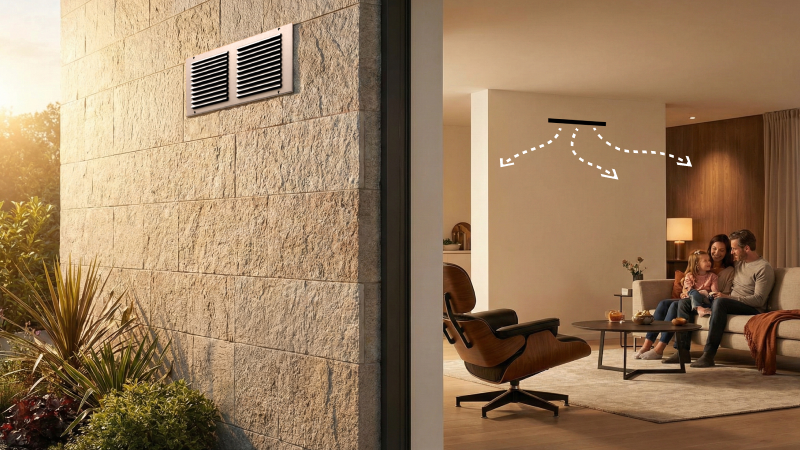
Double-flow controlled mechanical ventilation is one of the most effective solutions for ensuring clean air and indoor wellbeing. In this guide, you’ll find the essential information to understand how the system works and which factors to consider when choosing the best double-flow controlled mechanical ventilation solution.
What double-flow controlled mechanical ventilation is and why it’s worth installing
Double-flow controlled mechanical ventilation manages continuous indoor air exchange by supplying fresh air and extracting stale air through two separate airflows, without the need to open windows.
The main advantages of double-flow controlled mechanical ventilation include:
- Energy savings. Heat recovery limits energy losses associated with air exchange, reducing heating and cooling demand.
- Improved air quality. Filters capture dust, pollen and pollutants, improving the healthiness of indoor environments.
- Humidity and mould control. Continuous air renewal helps prevent condensation and mould growth.
- Acoustic comfort. Ventilation takes place with windows closed, avoiding external noise.
- Adaptability. Both centralised solutions for entire homes and decentralised units for individual rooms are available, making them suitable even for renovation projects.
Types of double-flow controlled mechanical ventilation
Classic double-flow system with heat recovery (MVHR)
The classic double-flow system with heat recovery ensures continuous air exchange while recovering heat, significantly reducing energy dispersion. The incoming air is preheated using the energy from the extracted air. This is the most widespread solution, thanks to its good balance between performance, ease of installation and cost-effectiveness.
Thermodynamic double-flow system
Thermodynamic double-flow controlled mechanical ventilation integrates a heat pump that allows the supply air to be thermally treated, supporting overall indoor comfort. While it does not replace a traditional heating or cooling system, it works in synergy with it, particularly in high energy-performance buildings. This is a more complex and costly solution, generally recommended for new builds or highly efficient design projects.
Different operating modes
Self-regulating controlled mechanical ventilation
Self-regulating controlled mechanical ventilation operates with a constant airflow, regardless of indoor conditions. Air exchange is continuous and always guaranteed, but it is generally less energy-efficient because it does not adapt to the actual needs of the environment.
Humidity-controlled controlled mechanical ventilation
Humidity-controlled controlled mechanical ventilation adjusts its operation based on the level of humidity detected in the rooms. The system increases or reduces air exchange only when necessary, allowing for more targeted air management and better control of energy consumption.
Efficiency and airflow rate
The efficiency of double-flow controlled mechanical ventilation indicates the ability of the heat exchanger to recover heat from the extracted air. To achieve a good balance between performance and energy consumption, it is advisable to choose a system with a heat recovery efficiency of at least 85%.
The airflow rate depends on the total volume of the home and must ensure adequate air exchange in all rooms. The minimum airflow rate can be calculated using the following formula:
Total volume of the spaces (m³) ÷ 2 = minimum airflow rate (m³/h)
Differences between single-flow and double-flow systems
The main difference between single-flow and double-flow controlled mechanical ventilation lies in how airflows are managed and whether heat recovery is present:
- Double-flow systems supply and extract air through two separate circuits, recovering up to around 90% of the heat from the outgoing air.
- Single-flow systems ensure air exchange through a simpler and less invasive setup. They are more affordable and usually require only one opening for installation, but they do not offer the same level of thermal recovery as double-flow systems.
Which one should you choose?
- Double-flow controlled mechanical ventilation: recommended for well-insulated homes, new buildings or energy refurbishment projects.
- Single-flow controlled mechanical ventilation: suitable for individual rooms or situations where more structured installations are not feasible.
Key features of double-flow controlled mechanical ventilation
Double-flow controlled mechanical ventilation stands out for two main characteristics:
- Energy savings and lower running costs. High heat recovery efficiency helps reduce heating and cooling demand, making double-flow systems more economical over time compared to solutions without heat recovery.
- Long-term affordability. Although the initial investment is higher than for single-flow systems, energy savings and improved comfort make double-flow controlled mechanical ventilation a financially sustainable choice in the long run.
What to pay attention to when choosing a double-flow system
Airflow rate based on the volume of the home
The system must be correctly sized according to the total volume of the house. An undersized system will not ensure effective air exchange, while an oversized one increases energy consumption and noise levels.
Motors and noise levels
Motor quality directly affects performance, efficiency and quiet operation. A good double-flow system should ensure low noise levels, especially in bedrooms.
High-quality ductwork
Air distribution ducts should be made of suitable materials, with smooth internal surfaces and proper insulation.
Duct diameter
Ducts that are too small force the system to operate at higher speeds, increasing both energy consumption and noise.
Duct installation
Correct installation is just as important: overly long runs, tight bends or poor installation practices reduce overall system efficiency.
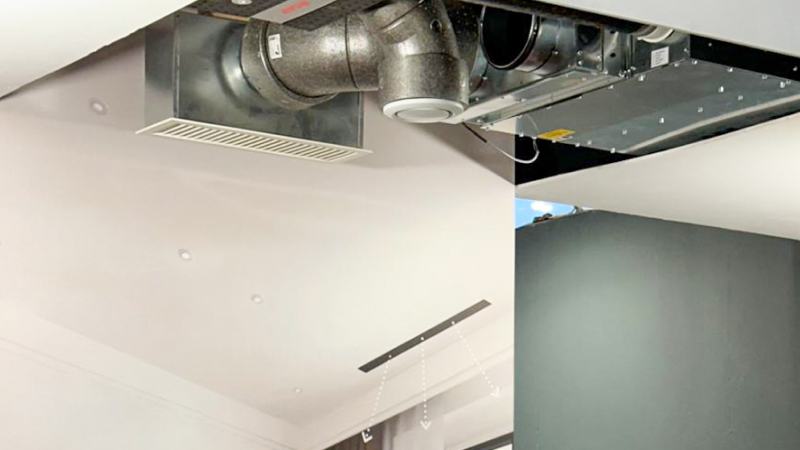
What to consider when choosing the best double-flow controlled mechanical ventilation system
Programmable interface
A good double-flow controlled mechanical ventilation system should feature a simple, programmable interface that allows users to manage schedules, ventilation speeds and operating modes easily.
Standards and certifications
It is important to check that the system complies with current regulations and is certified for energy efficiency, safety and build quality.
Bypass system
An automatic bypass makes it possible to exclude heat recovery when outdoor conditions are favourable, for example during cooler summer nights.
Self-regulating or humidity-controlled operation
The choice between self-regulating and humidity-controlled operation has a direct impact on energy consumption. Humidity-controlled systems adapt their operation to moisture levels, enabling more efficient air management than constant-flow solutions.
The best double-flow controlled mechanical ventilation system: IRSAP’s recommendation
When it comes to choosing the best double-flow controlled mechanical ventilation system, the right solution always depends on the residential context. In terms of performance and system integration, the most advanced option is thermodynamic double-flow controlled mechanical ventilation.
In particular, a thermodynamic system makes it possible to:
- ensure continuous controlled mechanical ventilation;
- support winter heating;
- cool and dehumidify the air during summer.
Because it is an advanced solution, thermodynamic controlled mechanical ventilation is not suitable for every building. The main aspects to consider are:
- Energy class of the building. It delivers its best performance in highly energy-efficient homes (A3-A4). In less insulated buildings, integration with other systems may be required.
- System complexity. This is a sophisticated solution that requires careful design and qualified technical support.
- Invasive installation. As a centralised system with ductwork, it is mainly suitable for new builds or major renovations, rather than light refurbishment projects.
EasyClima, IRSAP’s climatic ventilation solution, is designed as a true “lung of the home”. EasyClima integrates ventilation, air treatment and climatic comfort into a single system and is therefore correctly described as an HVAC system.
How to install controlled mechanical ventilation to optimise performance
Thermal insulation
Good building insulation is essential for double-flow controlled mechanical ventilation to be truly effective. In well-insulated homes, heat recovery works efficiently, while in poorly performing buildings heat losses reduce the system’s benefits.
Condensate drainage
During operation, controlled mechanical ventilation systems generate condensate that must be properly drained. A dedicated condensate outlet connected to the heat exchanger is therefore essential to ensure reliable operation and prevent long-term issues.
Filter maintenance
Air filters trap dust and pollutants and directly affect indoor air quality. They should be checked and replaced approximately every six months, in accordance with the manufacturer’s instructions.


