
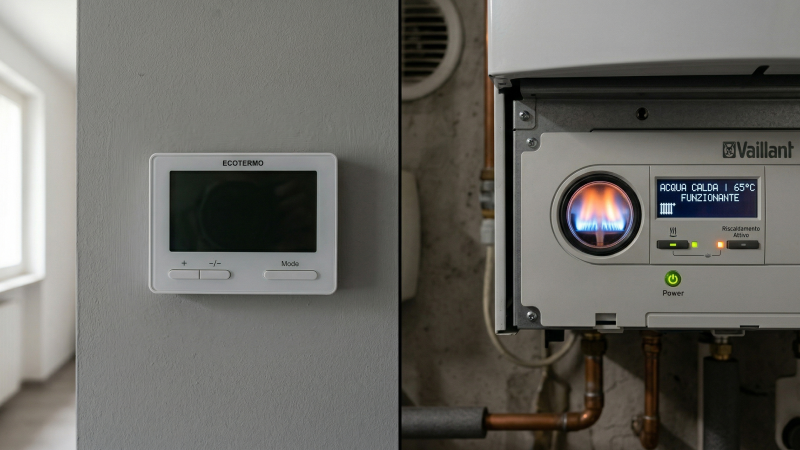
Have you ever switched off the thermostat and noticed that the boiler keeps turning on anyway, or that the radiators remain warm? It’s a more common situation than many people realise, especially during winter, when the heating system works more intensively.
In most cases, it is not necessarily a serious fault: the issue may depend on incorrect settings, heating system components operating independently or, in some cases, minor technical anomalies.
The good news is that you do not always need to call a technician immediately. Often, the cause can be identified with a few basic checks.
In this article, we’ll look at:
- the most common reasons why the boiler stays on even when the thermostat is switched off;
- the checks you can carry out yourself;
- when it is time to intervene or contact a professional.
Why does the boiler turn on even when the thermostat is off?
In most cases, the issue is linked either to communication problems between the thermostat and the heating system or to internal boiler components that are not functioning correctly.
Flat or faulty thermostat batteries
A thermostat without proper power supply may behave abnormally:
- it may send incorrect signals to the boiler;
- it may appear “off” but fail to interrupt the heating command correctly.
This is the first thing to check because it is quick and simple: often, replacing the batteries is enough to solve the problem.
Thermostat malfunction
The thermostat itself may be the cause, especially if it is old or inaccurate.
The most common cases include:
- faulty internal sensors;
- temperature reading errors;
- an outdated or unreliable device.
In these situations, it may be worth considering more advanced and precise systems - such as IRSAP NOW - capable of providing more stable regulation.
Stuck thermostat relay
The relay is the component responsible for opening or closing the electrical contact connected to the boiler.
If it becomes stuck:
- the boiler continues receiving the ignition command;
- the system remains active even when the thermostat is off.
Faulty three-way valve
The three-way valve directs water either towards the domestic hot water circuit or the heating system.
If it becomes stuck:
- it may send hot water to the radiators even without a heating request;
- radiators may become warm while using domestic hot water.
This is one of the most typical signs of this issue.
Boiler electronic board problems
The electronic board is the “brain” of the boiler and manages all commands.
A malfunction can cause:
- spontaneous ignition cycles;
- irregular system behaviour.
In this case, professional technical inspection is necessary.
Wiring or electrical connection problems
Connections between the thermostat and the boiler may also be responsible.
The most common situations include:
- damaged or incorrectly connected wires;
- loose contacts;
- signal interference between thermostat and boiler.
What to do immediately if the boiler starts by itself
Before calling a technician, there are several simple checks that can often identify or solve the issue independently.
Check and replace thermostat batteries
If the thermostat is battery-powered:
- check the battery charge level;
- replace batteries if they are weak or old.
Low batteries may cause incorrect signals or communication failures with the boiler.
Check thermostat settings
Make sure there are no active settings causing the boiler to start:
- summer/winter mode → ensure heating mode is not active;
- time schedules → check whether active heating programmes are set.
Sometimes the system works correctly but simply follows an unexpected schedule.
Switch the boiler off and restart it
A simple restart may solve minor electronic issues:
- switch off the boiler from the control panel or main switch;
- wait a few minutes;
- switch it back on.
This reset may clear temporary anomalies in the electronic board.
When the problem does not depend on the thermostat
Even if the thermostat works correctly, the issue may originate inside the heating system itself.
The most common situations involve:
- faulty valves → components such as the three-way valve or radiator valves may fail to close properly, allowing hot water to circulate even when heating is not requested;
- water circulation issues → pump or distribution problems may keep circulation active without demand;
- boiler components → the electronic board, sensors or other internal components may generate incorrect commands.
In these situations, the thermostat is not the cause; it simply cannot “control” an anomaly already present within the system.
When to call a technician
It is advisable to contact a professional when:
- the issue persists after basic checks;
- unusual noises, leaks or irregular behaviour are noticed;
- the malfunction involves internal boiler components (electronic board, valves, etc.).

How to prevent the boiler from turning on by itself in the future
These abnormal behaviours can often be prevented through proper maintenance, control and regulation quality.
-
Regular boiler maintenance. Routine inspections help identify anomalies early and keep the heating system operating efficiently.
-
Checking system components. Inspecting the condition of valves, sensors, electrical connections and system pressure helps prevent malfunctions over time.
-
More accurate control systems. Using advanced control systems - such as IRSAP NOW - allows more stable and precise heating management thanks to features like remote control and intelligent scheduling. The quality of heat emitters also plays an important role: radiators designed for even heat distribution improve the overall behaviour of the heating system.
Improving heating control: IRSAP solutions
L’integrazione tra regolazione intelligente e terminali efficienti consente di ottenere un impianto più stabile, preciso e coerente con le reali esigenze dell’abitazione.
Many of these problems originate from outdated heating systems where regulation is imprecise and components do not communicate efficiently with each other.
Today, heating control can be improved through solutions integrating:
- remote management and advanced regulation via IRSAP NOW;
- modern radiators designed to provide more even and responsive heat distribution, improving the performance of the entire system.
The integration of intelligent control systems with efficient heat emitters allows the creation of a heating system that is more stable, precise and aligned with the real needs of the home.


