
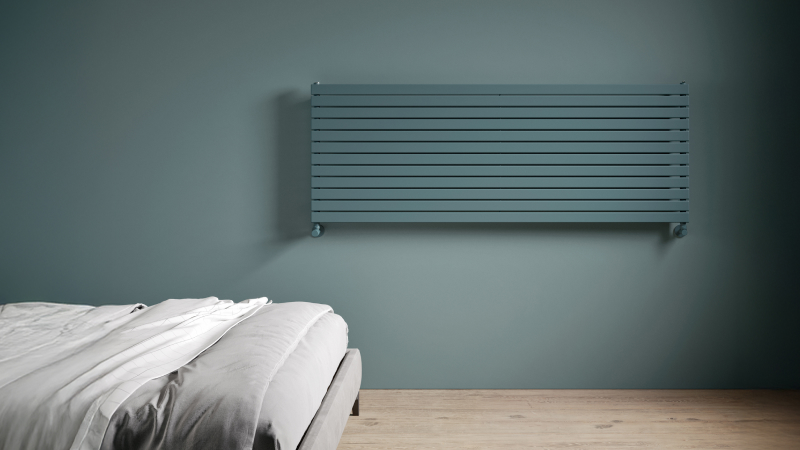
Underfloor heating or radiators: which is better? This is one of the most common questions when building a new home, renovating a property or upgrading a heating system.
Underfloor heating is often automatically considered the more modern and efficient solution, but the comparison is more complex. The characteristics of the property, heat generator, insulation, daily habits, type of work involved and available budget can all make one solution more suitable than the other.
Let’s look at how the two systems work, their main differences and, above all, how to choose the solution that best suits your home and your needs.
Underfloor heating and radiators: how do they work?
Underfloor heating uses a network of pipes installed beneath the floor, through which heated water circulates. The large surface area allows heat to be distributed evenly throughout the room and generally enables the system to operate with lower water temperatures.
Radiators, on the other hand, are heat emitters through which hot water from the heat generator circulates. They transfer heat to the room through a combination of radiation and convection and, in traditional systems, are often used with higher flow temperatures than underfloor heating.
However, this does not mean that all radiators necessarily need to operate at high temperatures: correct sizing, construction characteristics and heat exchange surface area can allow radiators to work effectively at lower temperatures too.
The main differences at a glance
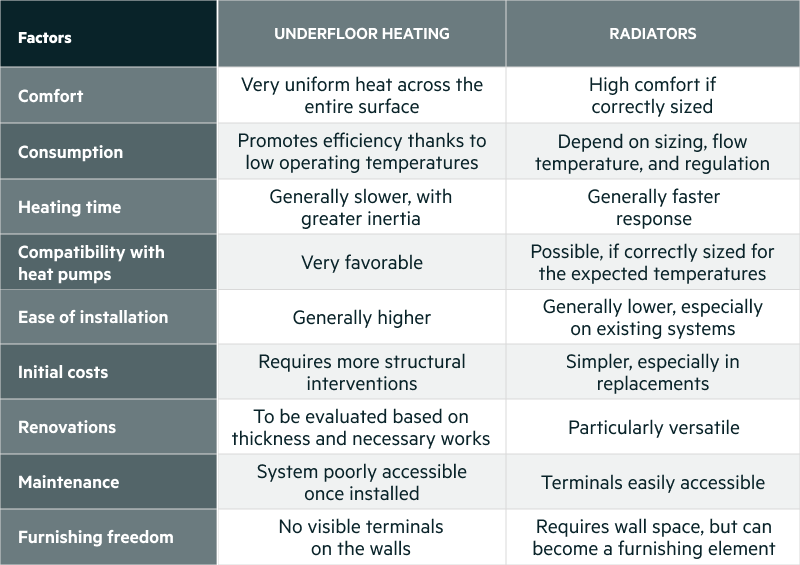
The table provides general guidance: the actual performance of both systems always depends on the overall system design and the characteristics of the building.
Everyday comfort: is there really such a big difference?
Underfloor heating provides an even distribution of heat, limiting temperature differences within the room. The floor surface contributes directly to heating the space, creating a widespread feeling of comfort and reducing particularly cold areas.
The issue of air movement should also be considered without oversimplifying it. Radiators generate more localised convection currents than radiant heating systems, but the presence of dust and allergens in the room depends on several factors, including cleaning, ventilation and indoor air quality. It is therefore incorrect to consider underfloor heating alone as a solution to allergy problems.
On the other hand, modern radiators can provide a high level of thermal comfort and have the advantage of responding more quickly to changes in the required temperature. Thermostatic valves and smart control systems also make it possible to set different comfort levels in different rooms.
Energy consumption: which system really saves more?
Underfloor heating generally operates with lower water temperatures, which can improve the efficiency of the heating system. However, this does not automatically mean that it consumes less energy than radiators: insulation, heat generator, controls, emitter sizing and usage habits all affect the final result.
To compare energy consumption properly, it is therefore necessary to consider the heating system as a whole and, in particular, the heat generator connected to the emitters.
The key factor: which heat generator will the system be combined with?
Underfloor heating and radiators are the emitters through which heat is distributed throughout the rooms. To assess their efficiency and cost-effectiveness, it is therefore also necessary to consider how that heat is generated.
With a heat pump, operating with lower water temperatures generally improves system efficiency. This makes underfloor heating a particularly suitable combination. However, radiators should not be ruled out: if they are correctly sized to provide the required output at the temperatures specified by the system design, they can also be used with a heat pump.
A condensing boiler offers greater flexibility in terms of flow temperatures and can easily be integrated with radiators. Even in this case, however, sufficiently low return temperatures encourage condensation and therefore improve efficiency.
In hybrid systems, the heat pump and boiler are coordinated according to operating conditions. The choice of emitters must therefore take into account the temperatures expected under the different operating modes.
Heating times: is a fast system better, or one that retains heat?
One of the most noticeable differences concerns thermal inertia.
Underfloor heating generally takes longer to significantly change the room temperature, but once the desired conditions have been reached, it provides very consistent heat output. It can therefore be particularly suitable for homes occupied for many hours during the day and managed at relatively constant temperatures.
Radiators generally have a faster response time. They can therefore be practical when you want to change the temperature more quickly, for example if you spend most of the day away from home or in properties that are only used occasionally, such as holiday homes.
The choice therefore also depends on how the property is actually used, not just on the theoretical efficiency of the two systems.
Which solution is best for a new home? And for a renovation?
In a new-build property, there is maximum design freedom. Underfloor heating can be planned from the outset, taking into account the necessary floor depths, a highly insulated building envelope and a low-temperature heat generator such as a heat pump. This is therefore one of the scenarios in which this solution is easiest to integrate.
During a renovation, however, the starting point is different. Installing underfloor heating may involve removing the existing flooring, checking the available floor depth and carrying out other building work. Its feasibility must therefore be assessed according to the type and extent of the renovation.
If the aim is to upgrade the heating system while limiting demolition and building work, keeping or replacing the radiators can be considerably simpler. In some cases, part of the existing pipework can also be retained, provided its suitability for the new system is verified.
How much do installation and maintenance matter?
The economic comparison should not stop at the price of the heat emitters. It is important to consider the entire life cycle of the system, starting with the work required for installation.
Underfloor heating requires more structural work and must be coordinated with screeds, flooring and the available floor levels. Once completed, much of the system is also embedded within the floor structure, meaning that any future work on the pipes can be more complex.
Radiators, on the other hand, are visible and easily accessible, making it easier to replace or service individual units. During a renovation, they can also help reduce installation time and building work when the existing system can be at least partially retained.
Is it possible to replace radiators with underfloor heating?
Yes, but the feasibility of the work must first be assessed by considering the available floor depth, characteristics of the floor structure and flooring, insulation, pipe distribution, heating requirements and compatibility with the heat generator.
Because of the work involved, switching to underfloor heating is generally easier as part of a complete renovation than as an intervention limited solely to replacing the heating system.
What if the choice were not “underfloor heating or radiators”, but modern radiators?
When comparing underfloor heating and radiators, there is often a tendency to associate the latter with traditional high-temperature heating systems. Today, however, radiators are available in different materials, sizes and configurations and can be sized to meet the requirements of modern heating systems.
Aluminium radiators, for example, have low thermal inertia and respond quickly to changes in the required temperature. Steel radiators, meanwhile, are available in a wide range of shapes and sizes, making it possible to select the appropriate heat exchange surface for the output required in each room.
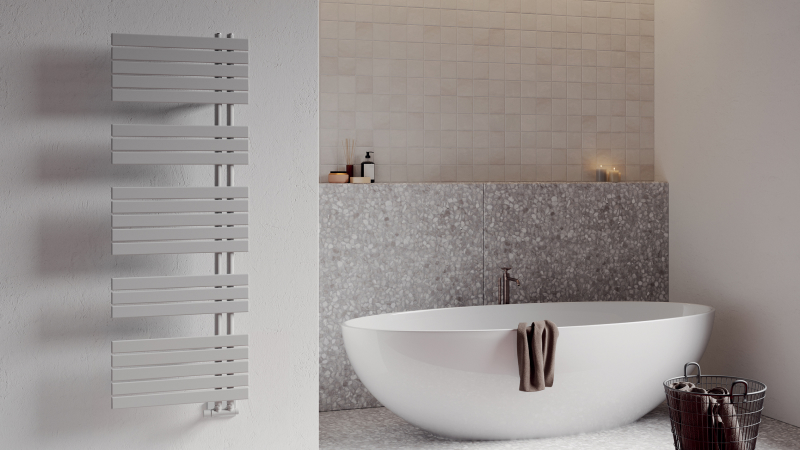
Aesthetics have also evolved: IRSAP design radiators can be integrated into interior design projects, turning the heat emitter into a distinctive feature of the space.
The choice should therefore not be based on the idea that radiators are an outdated technology, but rather on the performance required by the heating system. With low-temperature systems or heat pumps, it is essential to ensure that the radiator is correctly sized to provide the necessary output at the actual flow and return temperatures specified by the system design.
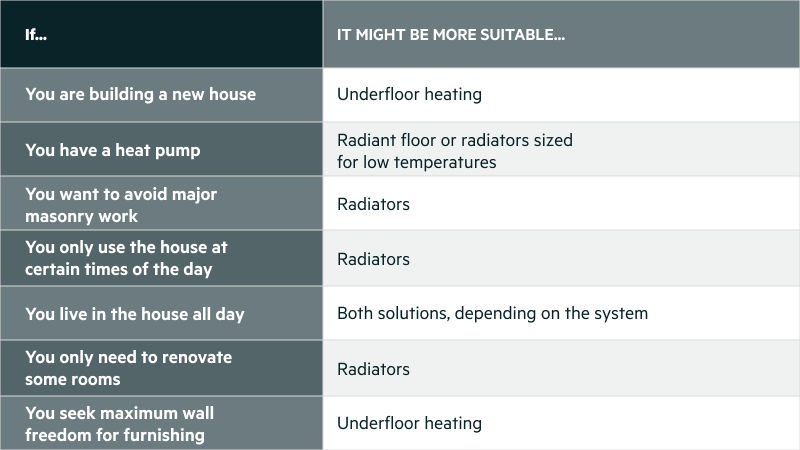
Which solution should you choose? It mainly depends on your situation
IRSAP solutions for efficient heating
IRSAP offers a range of solutions designed to adapt heating to the characteristics of the property and its heating system. The range includes hydronic radiators in different materials, sizes and configurations, as well as electric radiators for specific heating requirements.
The choice of heat emitters can also be complemented by IRSAP NOW, the smart heating management system. Using a smart thermostat and smart thermostatic valves, temperatures in different rooms can be programmed and controlled according to individual habits, including remotely.
In this way, choosing a radiator becomes part of a more comprehensive approach to home comfort that considers heat emitters, heat generator and temperature control together.
FAQ
Which is better: underfloor heating or radiators?
It depends on the building and how the heating system is used. Underfloor heating is particularly attractive in new-build properties and low-temperature systems, while radiators offer faster response times and may be easier to install during renovations.
Does underfloor heating really use less energy?
Not necessarily. Compared with older high-temperature radiators, underfloor heating can be more efficient. However, the comparison changes when modern low-temperature steel radiators are considered, especially when they are controlled room by room: thanks to their faster response time, they can adapt heating to actual daily habits and avoid unnecessarily heating rooms when the house is empty.
Can radiators work with a heat pump?
Yes, radiators can work perfectly well with a heat pump, but there is one essential condition: they must be designed to operate at low temperatures.
How much does it cost to install underfloor heating?
The cost varies significantly depending on the surface area, the system chosen and, above all, the work required. In a new-build property or a complete renovation, the impact of installation work can be very different from a project carried out solely to replace the heating system.
Is it possible to switch from radiators to underfloor heating?
Yes, it is technically possible to switch from radiators to an underfloor heating system, but it requires very extensive work.
Are modern radiators still efficient?
Yes, modern radiators are still highly efficient and play an important role in the evolution of sustainable home heating. The idea that radiators are outdated or inefficient is largely associated with older cast-iron systems. Modern radiators, particularly steel models, can offer excellent performance.
Which solution increases property value the most?
There is no automatic relationship between the type of heat emitter and property value. Overall energy efficiency, system quality, comfort, the condition of the building and local property market characteristics all contribute to the final valuation.


