
Are you renovating your home or looking to replace old radiators, but not sure where to start? It’s a very common situation: when faced with the choice between aluminium, steel or cast iron radiators, the same question always comes up - which one is actually the best option?
Many homeowners start from existing cast iron radiators, still found in many properties, and wonder whether it makes sense to keep them or switch to more modern solutions. At the same time, aluminium and steel radiators are often presented as alternatives, but the real differences in terms of performance, energy efficiency and thermal comfort are not always clear.
The truth is that there is no single right answer: the best choice depends on the heating system, lifestyle habits and the characteristics of the home itself.
In this article, we’ll help you understand:
-
the differences between aluminium, steel and cast iron radiators;
-
the advantages and limitations of each material;
-
when it makes sense to choose one solution over another.
Aluminium, steel and cast iron radiators: the main differences
Choosing the radiator material is not just about aesthetics or construction: it directly affects how the home heats up and how efficiently the system operates.
The main differences between aluminium, steel and cast iron radiators come down to three aspects:
-
Heating response time: how quickly the radiator heats up and starts releasing warmth.
-
Heat retention: how long it continues to emit heat after the system switches off.
-
Impact on comfort and efficiency: how responsive, stable and efficient the heating system feels over time.
Each material behaves differently in these areas, which is why the right choice depends on the specific needs of the building and the heating system.
In the next section, we’ll look at a direct comparison to make these differences easier to understand.
Aluminium vs steel vs cast iron radiators: a practical comparison
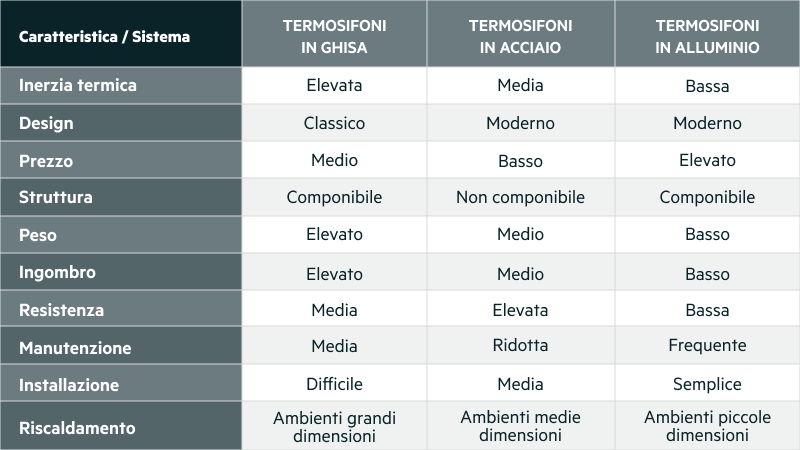
The comparison clearly shows that there is no universally “best” material, but rather solutions that suit different needs.
-
Aluminium radiators heat up very quickly, making them ideal for responsive heating systems, although they retain less heat once switched off.
-
Cast iron radiators are the opposite: slower to reach temperature, but capable of releasing heat for a long time, ideal for stable and continuous thermal comfort.
-
Steel radiators offer a balance between performance and design flexibility, with intermediate response times and even heat distribution.
In practice, the right choice often depends on your lifestyle:
-
If your home is occupied mainly in the morning and evening, more responsive materials are generally preferable.
-
If you spend most of the day at home - for example while working remotely, or in households with children or elderly people - materials with higher heat retention may help maintain more stable indoor temperatures.
Design and space also play an important role: if you are looking for a balance between aesthetics and functionality, steel is often the most versatile solution.
This provides a useful starting point, but in the next sections we’ll look more closely at when each material is most suitable.
Aluminium radiators: features, advantages and drawbacks
Aluminium radiators are among the most common choices in modern heating systems, mainly because of their high responsiveness.
In practical terms, they heat up very quickly and start diffusing warmth almost immediately. They also respond rapidly to thermostat adjustments, making temperature regulation more dynamic and precise.
This makes them particularly suitable for:
-
modern, well-insulated homes;
-
properties where heating is used intermittently;
-
situations where fast temperature control is important.
Advantages
-
Fast heating response;
-
More precise temperature control;
-
Lightweight and easy to install;
-
Good compatibility with low-temperature heating systems.
Drawbacks
-
Lower thermal inertia: heat dissipates more quickly once the system is switched off;
-
Less suitable for those seeking long-lasting residual heat;
-
In some cases, they may require more careful regulation to avoid temperature fluctuations.
Steel radiators: features, advantages and drawbacks
Steel radiators are one of the most widely used solutions today because they offer a good balance between heat output, design and versatility.
From a practical perspective, they respond more gradually than aluminium radiators, but faster than cast iron. This creates a more stable and even heat distribution, contributing to improved thermal comfort throughout the home.
One of steel’s main strengths is precisely its ability to distribute heat evenly, reducing sudden temperature variations and creating a more consistent indoor environment.
Advantages
-
Good balance between responsiveness and heat retention;
-
Even heat distribution for more stable thermal comfort;
-
Wide design flexibility in terms of shapes, sizes and finishes;
-
Ideal for those looking for both performance and aesthetics.
Drawbacks
-
Less reactive than aluminium during rapid temperature changes;
-
Lower heat retention compared to cast iron;
-
Many models are not modular.
Because of these characteristics, steel is often used in designer radiators, where performance and architectural integration go hand in hand.
Examples include the solutions within the IRSAP radiator range, which features steel models designed for contemporary interiors, with particular attention to both heat performance and visual impact, such as panel radiators and vertical designer radiators.
In summary, steel is the right choice if you are looking for a balanced, modern and comfortable radiator that integrates naturally into contemporary spaces.
Cast iron radiators: when do they still make sense?
Many homeowners face the same question: is it worth keeping old cast iron radiators or replacing them?
Cast iron is a traditional material still found in many homes, known for one distinctive characteristic: high thermal inertia. This means it takes longer to heat up, but once at temperature it continues releasing heat for a long time, even after the system has been switched off.
When it still makes sense to keep them
-
In older heating systems originally designed around cast iron radiators;
-
If stable and continuous heat output is the priority;
-
In homes where heating stays on for long periods throughout the day.
Limitations
-
Slow response times;
-
Less suitable for modern low-temperature systems unless correctly sized;
-
Large dimensions and significant weight;
-
Reduced compatibility with advanced heating controls and smart regulation systems.
Aluminium or steel radiators: which is better?
The choice between aluminium and steel mainly depends on how you want to manage heating in your home.
-
If responsiveness and fast control are priorities, aluminium is generally the better option. It heats up quickly and reacts immediately to thermostat adjustments, making it ideal for intermittent heating schedules or rapid temperature changes.
-
If you are looking for balanced thermal comfort and design flexibility, steel is often the preferred solution. It provides more even and stable heat distribution while also offering greater aesthetic versatility.
Should you keep cast iron radiators or replace them?
The answer depends on how your current heating system performs and what you expect from it.
Replacing old radiators is often worth considering when:
-
energy consumption is high compared to the comfort achieved;
-
room temperatures are difficult to regulate;
-
heat distribution is uneven between rooms;
-
renovation work or heating system upgrades are already planned.
In these situations, switching to modern radiators can improve:
-
energy efficiency;
-
temperature control;
-
overall comfort.
If the existing system still performs well and there are no specific comfort or efficiency issues, cast iron radiators can still remain a valid option. However, when limitations in control or energy performance become evident, replacement increasingly becomes the more effective long-term solution.
How to choose the right radiator for your home
Choosing the right radiator is not only about the material itself, but also about the characteristics of the building and how the heating system is used. Here are a few practical examples to help you get started:
-
Modern, well-insulated homes. These environments benefit from responsive systems such as aluminium or steel radiators. Because heat loss is limited, fast-reacting radiators help avoid overheating and improve efficiency.
-
Larger or poorly insulated homes. Buildings with higher heat dispersion often benefit from greater thermal inertia, making cast iron or steel more suitable for maintaining stable indoor temperatures.
-
Homes where design matters. If architectural integration and aesthetics are important, steel radiators generally offer the greatest design flexibility, allowing the radiator to become part of the interior design rather than simply a functional component.
The role of the radiator in heating efficiency
Often considered simply the final component of the heating system, the radiator is actually one of the key elements of domestic comfort, because it is the point where energy is transformed into the heat we physically perceive. Choosing the right heat emitter therefore has a direct impact on three fundamental aspects of everyday living:
-
Heat distribution, meaning how stable and uniform the temperature remains throughout each room. While different materials provide different thermal responses, technology makes it possible to go one step further: ventilated radiators, such as the Relax range, ensure an even softer and more enveloping heat distribution. An advanced solution specifically designed to enhance the performance and comfort of modern heat pump systems.
-
Efficiency and energy consumption: a well-designed radiator helps optimise the operation of the heat generator. Today, technology adapts to the living space through modular solutions such as Ellipsis, a model capable of flexibly adapting to the dimensions and layout of each environment. This versatility allows for more precise “tailored” sizing, ensuring the exact heat output required for every room while helping reduce energy waste.
-
Aesthetics and architectural integration: a radiator is also a furnishing element and should blend naturally with the personality of the home. This vision is central to IRSAP’s philosophy and finds one of its clearest expressions in the Tesi model: a timeless icon of radiator design. A solution capable of integrating naturally with virtually any interior style, transforming a functional necessity into a genuine design feature.
Improving comfort and efficiency: IRSAP solutions
Today, choosing radiators is no longer just a technical decision related to materials, but part of a broader approach to indoor wellbeing.
In particular, it is important to consider:
-
energy efficiency, to reduce consumption without compromising comfort;
-
temperature control, to adapt heating to everyday habits and lifestyles;
-
integration with modern systems, such as advanced boilers or smart solutions.
In this context, IRSAP solutions combine performance with intelligent heat management. IRSAP radiators are designed to operate efficiently even with modern heating systems, while solutions such as IRSAP NOW allow precise and flexible temperature control.
The result is a heating system that is more efficient, easier to manage and genuinely focused on everyday comfort, not only from a thermal perspective, but also in day-to-day usability.


