
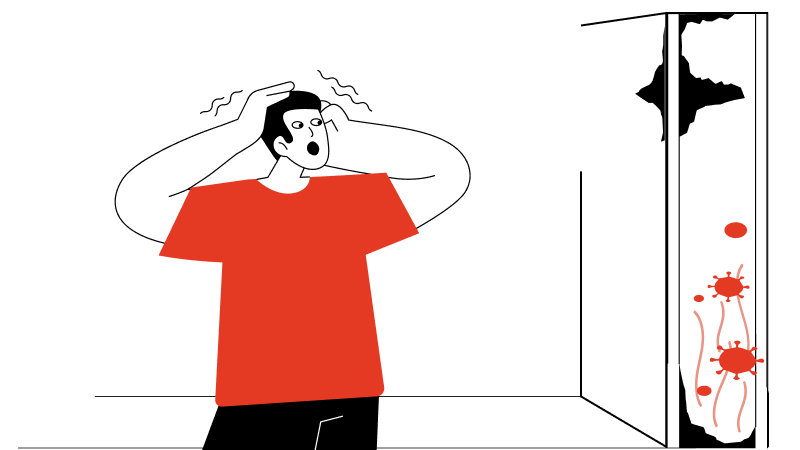
Black stains in the corners of walls, a persistent damp smell, mold that keeps returning even after repeated cleaning. It is a very common - and often frustrating - situation.
You may already have tried everything: anti-mold products, specific paints, or improving natural ventilation. Yet the problem never seems to disappear completely.
The key point is this: mold is not the cause, but the consequence. It develops when indoor environmental conditions are unfavorable, especially in the presence of high humidity and poor ventilation.
This is where controlled mechanical ventilation comes into play, an increasingly common solution for improving indoor air quality and reducing humidity. However, it is important to clarify immediately: it is not a universal solution, but an effective tool only when applied in the right context.
In this article, we will explain:
-
why mold forms
-
when controlled mechanical ventilation can truly solve the problem
-
and when other types of intervention are necessary
What is mold and why does it form on walls?
Mold develops when several favorable conditions occur inside the home:
-
high humidity
-
poor ventilation
-
cold surfaces
When these factors combine, dark stains begin to appear on walls, ceilings, or corners.
Humidity and condensation
Indoor air always contains a certain amount of moisture. The problem begins when this humidity settles on colder surfaces and turns into condensation.
This stagnant moisture on walls creates the ideal environment for mold growth.
Poor ventilation
If indoor air is not renewed regularly, humidity remains trapped and accumulates over time.
Opening windows can help, but it is often not enough or not practical:
-
heat is lost during winter
-
it is not always possible to ventilate frequently
-
in some homes, air circulation is naturally ineffective
Thermal bridges and cold surfaces
Some areas of a home are naturally colder, such as corners, exposed walls, or areas near pillars and window frames.
These areas, known as thermal bridges, are more prone to condensation and mold growth, even if the rest of the room appears dry.
Why does mold keep coming back even after cleaning?
Cleaning mold removes it visually, but it does not solve the root cause.
Anti-mold products act only on the surface. If the original conditions remain unchanged - high humidity, poor ventilation, and cold surfaces - mold will return.
That is why stains often reappear in the same spots after only a few weeks or months.
The real solution is therefore not simply removing mold, but addressing its causes:
-
reducing indoor humidity
-
improving air exchange
-
limiting condensation formation
Mold remedies: what actually works?
Temporary solutions
There are several remedies that help manage mold, but many only address the symptoms rather than the causes.
-
Anti-mold sprays. Remove visible stains but do not prevent mold from returning.
-
Special anti-mold paints. Slow down recurrence but do not solve humidity or ventilation issues.
-
Dehumidifiers. Reduce moisture in the air, but only if used continuously and only within the room where they are placed.
Structural solutions
To solve mold problems effectively, it is necessary to act on the underlying causes:
-
improving ventilation
-
reducing humidity continuously
-
addressing insulation issues and thermal bridges, when present

Controlled Mechanical Ventilation for mold: how it works and why it is effective
Controlled mechanical ventilation works in a simple yet highly effective way: it continuously renews indoor air.
This produces three main effects:
-
it reduces indoor humidity by expelling moisture-laden air
-
it introduces cleaner and drier outdoor air
-
it helps prevent condensation on cold surfaces
Decentralized or centralized Controlled Mechanical Ventilation: which one should you choose?
Decentralized Controlled Mechanical Ventilation (for localized problems)
A decentralized controlled mechanical ventilation system is suitable when the issue is limited to one or a few rooms.
It makes sense when:
-
mold is present only in specific spaces (for example bathrooms or bedrooms)
-
a less invasive intervention is preferred
-
no major renovation work is being done
It is a targeted and easier-to-install solution.
Centralized Controlled Mechanical Ventilation (complete solution)
A centralized controlled mechanical ventilation system is more suitable when the problem affects the entire home or when a long-term solution is desired.
It is the right choice for:
-
full renovations
-
new constructions
-
widespread humidity and stagnant air issues
It ensures consistent air renewal throughout the whole building.
Does Controlled Mechanical Ventilation always solve mold problems?
Controlled mechanical ventilation is an excellent technology for indoor wellbeing, but it must operate within the correct context to deliver its full potential.
Its action is particularly effective when mold is caused by everyday indoor humidity combined with insufficient air exchange.
However, if the root cause lies in serious building issues, such as water infiltration from outside or severely inadequate insulation, ventilation alone cannot solve the problem and must be integrated into a broader remediation project.
Practical tips to prevent mold at home
In addition to heating and ventilation systems, some everyday habits can help prevent mold growth.
-
Ventilate correctly. It is better to open windows for short but effective periods, creating air circulation, rather than leaving them slightly open for long periods.
-
Avoid excess humidity. Activities such as cooking, showering, or drying laundry indoors increase humidity levels and should be managed carefully using extractor hoods, ventilation, or other solutions.
-
Maintain stable temperatures. Avoiding sudden temperature fluctuations helps reduce condensation on walls and surfaces.
When does it make sense to install controlled mechanical ventilation for mold?
Installing controlled mechanical ventilation is worth considering when:
-
mold keeps returning despite superficial treatments
-
rooms are poorly ventilated or difficult to air out
-
the house is highly insulated and humidity tends to remain trapped indoors

Eliminating mold and improving comfort: IRSAP solutions
Indoor comfort depends on the balance between several interconnected factors:
-
air quality, to reduce humidity and pollutants
-
indoor temperature, to avoid cold surfaces and condensation
-
intelligent heating control, to maintain stable conditions over time
IRSAP AIR solutions are designed with this approach in mind: the VMC units ensure high indoor air quality, while the EasyClima system maximizes climate control comfort, especially when combined with the IRSAP NOW ecosystem, which ensures precise and continuous temperature control, even remotely.
The result is a healthier, more balanced, and more comfortable environment where mold can no longer thrive.


