
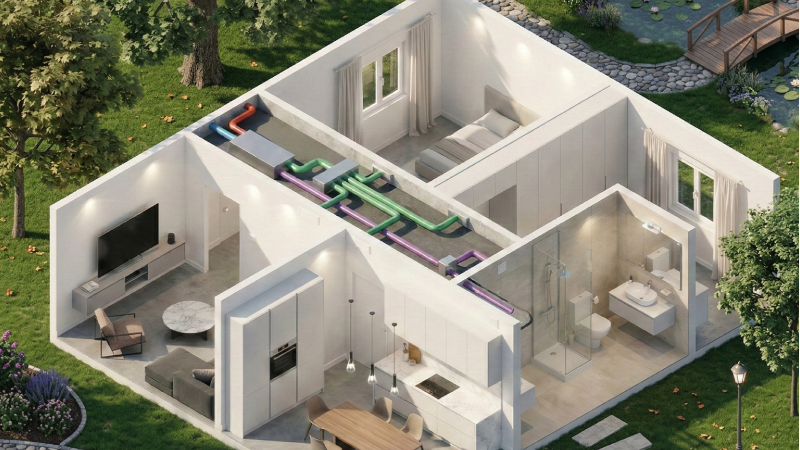
Do you struggle with stale indoor air, condensation on windows or mould that keeps returning in the corners of your home? Opening the windows helps, but it is often not enough and, moreover, it causes heat loss in winter and unwanted heat gain in summer.
This is where a controlled mechanical ventilation (CMV) system comes into play. Many homeowners see it as an effective solution, but also an expensive one. The questions are always the same: how much does it really cost? And is it worth the investment?
In this article, we’ll look at:
-
how much a controlled mechanical ventilation system costs;
-
what factors influence the price;
-
which solution is best suited to different needs.
What is a Controlled Mechanical Ventilation System and what is it for
A controlled mechanical ventilation system continuously renews indoor air without requiring windows to be opened.
In practice, it:
-
extracts stale indoor air (containing humidity and pollutants)
-
introduces fresh, filtered outdoor air
The benefits are tangible:
-
improved indoor air quality
-
reduced humidity levels
-
lower risk of condensation and mould
-
enhanced living comfort
It is a solution designed to improve indoor wellbeing continuously and automatically, without the need to manually open windows throughout the day.
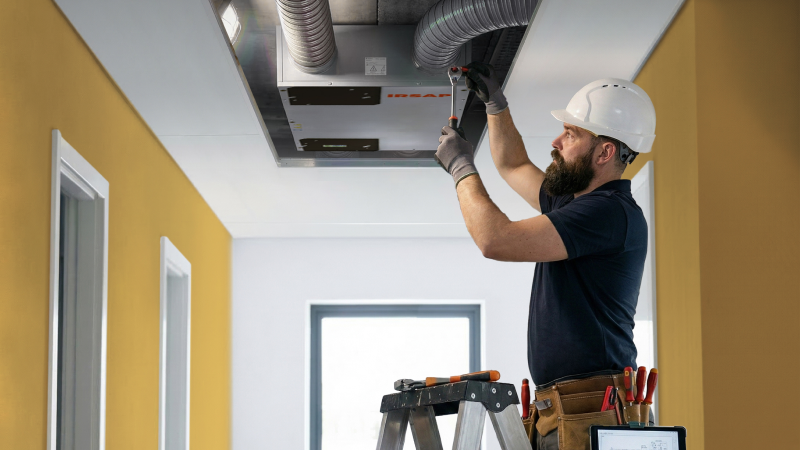
How much does a Controlled Mechanical Ventilation system cost?
The cost of a controlled mechanical ventilation system varies significantly depending on the type selected and the installation context. Installing the system in a new-build property differs considerably from integrating it into a renovation project.
Cost of a decentralised system
A decentralised controlled mechanical ventilation system is generally the most affordable option.
-
Indicative price (unit only, installation excluded): €250-€800
-
It is designed for individual rooms, so the overall cost depends on the number of spaces requiring treatment.
What is included:
-
controlled mechanical ventilation system unit;
-
basic wall-mounted installation.
It is the simplest and least invasive solution, particularly suitable for light renovation projects.
Cost of a Centralised Controlled Mechanical Ventilation system
A centralised controlled mechanical ventilation system involves a higher investment because it serves the entire home.
-
Indicative price (excluding suspended ceiling works): approximately €5,000-€15,000 for an average-sized dwelling.
Why does it cost more?
-
system design
-
central ventilation unit
-
ductwork (often concealed within suspended ceilings)
-
more complex installation
It is a more substantial investment, but also a more effective and integrated solution, especially in new constructions and complete renovations.
Cost Components of a Controlled Mechanical Ventilation system
The final cost of a controlled mechanical ventilation system depends on several elements.
Ventilation unit and technology
The ventilation unit is the core of the system. More advanced solutions, such as heat recovery systems, typically cost more but offer superior performance.
Airflow capacity
The required airflow rate depends directly on the size of the property. Larger floor areas require greater air treatment capacity, which has a direct impact on investment costs.
Heat exchanger
The heat exchanger is responsible for recovering energy from outgoing air. Choosing a high-efficiency heat exchanger requires a greater initial investment, but this is generally offset over time through lower energy consumption.
Filters and indoor air quality
Filter selection determines indoor air purity levels. More advanced filtration technologies remove allergens and pollutants more effectively. These higher performance levels may require a more sophisticated system configuration and regular maintenance, but they deliver significantly improved indoor comfort.
Sensors and automation
Integrating humidity or CO₂ sensors makes the system truly intelligent. Automated operation helps maintain optimal comfort while adapting energy consumption to the actual needs of the building. This technological upgrade enhances both indoor wellbeing and system efficiency.
Optional features and additional functions
A controlled mechanical ventilation system can be enhanced with advanced features such as:
-
remote management via app;
-
integration with modern smart-home ecosystems.
These options allow the system to be tailored more closely to daily habits and specific household requirements.
Other factors that affect the cost of a Controlled Mechanical Ventilation system
Property size and layout
The configuration of the building determines system complexity. In smaller homes (for example, around 60 m²), air distribution can often be achieved with relatively simple layouts.
In larger homes or properties spread across multiple floors (for example, around 120 m²), a more detailed ductwork design is required to ensure consistent and uniform air renewal throughout the building.
New build or renovation
In new-build projects, the system can be integrated from the design phase with maximum flexibility. In renovation projects, however, the installation must adapt to existing architectural constraints. This may require bespoke technical solutions, which can influence the overall budget.
Building works and installation
In many cases, the most significant cost component relates to the building work required for integration. Wall penetrations, suspended ceilings and duct routing require careful planning and skilled execution to preserve the appearance of the property while ensuring optimal ventilation performance.
How much electricity does a Controlled Mechanical Ventilation system consume
Energy consumption is generally modest.
The main advantage of heat recovery systems is that they allow continuous ventilation without significant heat loss.
This means:
-
reduced heat dispersion;
-
lower heating and cooling losses;
-
limited impact on energy bills overall.
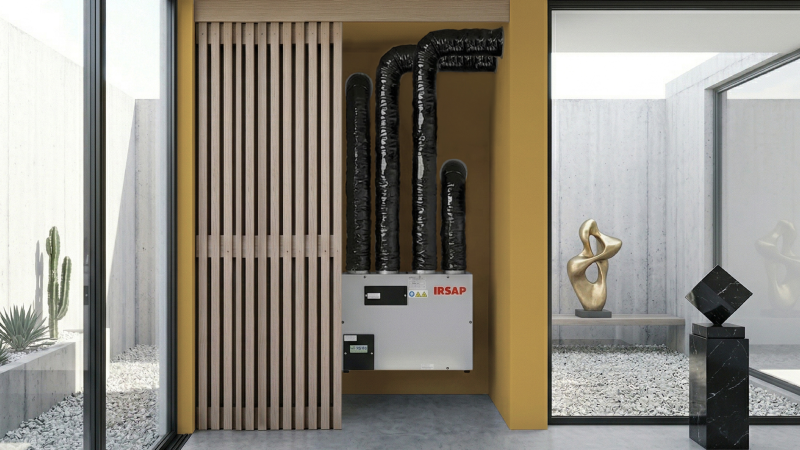
Controlled Mechanical Ventilation and energy savings: is it really worth it?
The initial investment may seem significant, but it should be considered alongside the long-term benefits.
An efficient controlled mechanical ventilation system:
-
reduces energy losses through heat recovery;
-
improves indoor comfort;
-
helps optimise heating and cooling consumption.
How to choose the right Controlled Mechanical Ventilation system
There is no single solution suitable for every home. The ideal choice depends on the project, the occupants’ priorities and the balance between comfort and investment.
-
Layout and floor area. For compact homes or individual rooms, decentralised ventilation systems offer a practical and minimally invasive solution. For larger homes or multi-storey properties, a centralised system is generally the preferred option, ensuring consistent air renewal throughout the building.
-
Indoor air quality issues. If the problem is limited to a specific room affected by mould or condensation, a targeted solution is often sufficient. When humidity and poor air quality affect multiple rooms, however, a whole-house system is usually the most effective approach.
-
Investment perspective. The choice between decentralised and centralised systems (with heat recovery) significantly influences the level of investment. While decentralised units provide an immediate and accessible solution, a centralised system represents a long-term investment that maximises energy efficiency and can increase property value.
When is it worth installing a Controlled Mechanical Ventilation system?
There are specific situations where natural ventilation is no longer sufficient or efficient. A controlled mechanical ventilation system becomes particularly valuable when:
-
Persistent mould or humidity is present. Especially when mould continues to return despite repeated surface treatments.
-
The house is highly airtight. In modern, well-insulated homes, air exchange occurs less naturally, increasing the risk of humidity accumulation.
-
During renovations or new construction. These are ideal opportunities to integrate the system efficiently and effectively.
Improving comfort and indoor air quality: integrated IRSAP solutions
Today, indoor comfort depends on three key factors:
-
air quality, to reduce humidity and indoor pollutants;
-
temperature control, to prevent condensation and uncomfortable fluctuations;
-
intelligent systems, to manage everything efficiently.
IRSAP AIR solutions fit perfectly into this approach. Controlled mechanical ventilation units ensure excellent indoor air quality, while EasyClima HVAC systems maximise climate comfort. When combined with the IRSAP NOW ecosystem, they provide precise and continuous temperature control, including remote management.
The result is a healthier, more efficient and more comfortable living environment, where fresh air and thermal comfort work together seamlessly.


