
High humidity, condensation on windows, mould in corners and stale air are very common problems in modern homes, especially in well-insulated buildings where natural air exchange is reduced.
In these situations, a common question often arises: is it better to buy a dehumidifier or install a controlled mechanical ventilation system?
The confusion is understandable, because both solutions are related to humidity and indoor comfort. In reality, however, they perform different functions.
A dehumidifier is mainly used to reduce the humidity present in the air. controlled mechanical ventilation, on the other hand, ensures continuous indoor air exchange, improving air quality and healthiness.
In this guide, we will look at:
-
when to choose a dehumidifier;
-
when controlled mechanical ventilation is more suitable;
-
which problems they really solve;
-
why, in some cases, the two technologies can work together.
Dehumidifier and controlled mechanical ventilation: what is the difference?
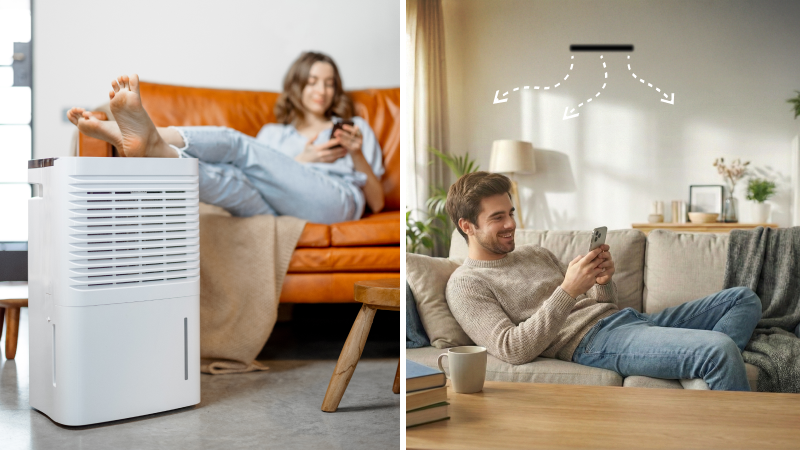
Although they are often compared, dehumidifiers and controlled mechanical ventilation systems do not do the same thing.
A dehumidifier acts on the air inside the rooms by dehumidifying it, while controlled mechanical ventilation works on indoor air quality through the continuous exchange of indoor air with air taken from outside.
How a dehumidifier works
A dehumidifier draws in the air from the room, removes part of the humidity and releases drier air back into the environment.
It is mainly used when:
-
humidity is high;
-
condensation forms.
Its main advantage is its ability to quickly reduce excess humidity.
However:
-
it does not ensure air exchange;
-
it does not introduce fresh air from outside;
-
it does not remove pollutants present in indoor environments.
In practice, it improves the humidity level, but does not solve problems related to indoor air quality on its own.
How controlled mechanical ventilation works
Controlled mechanical ventilation works differently.
The system:
-
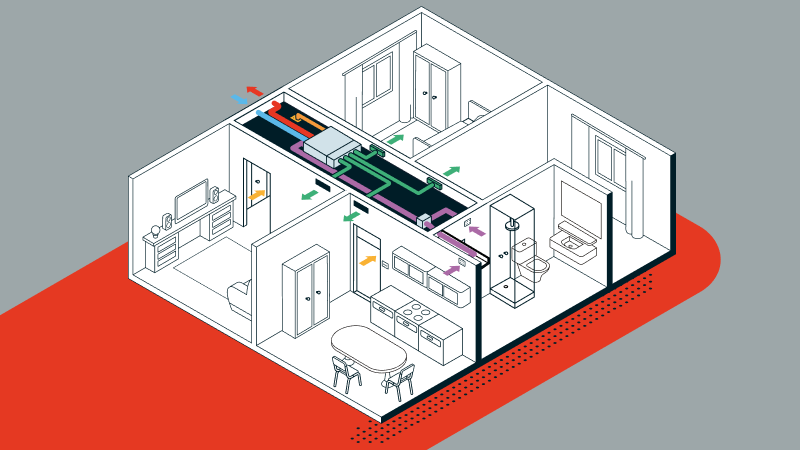
extracts stale air from indoor environments;
-
introduces fresh, filtered air from outside.
This makes it possible to continuously improve:
-
air quality;
-
home comfort.
The most advanced systems allow heat exchange between the extracted air and the air introduced into the rooms through a heat exchanger, which uses the heat from the expelled air to preheat the incoming air. In this way, energy losses are reduced while maintaining a good level of ventilation in both summer and winter.
When it is best to choose a dehumidifier
A dehumidifier can be an effective solution when the main problem is related to the humidity present in the rooms.
For example:
-
temporary humidity during certain periods of the year;
-
bathroom without windows;
-
drying laundry indoors;
-
particularly humid rooms without structural problems.
In these situations, it helps to quickly improve perceived comfort.
However, it is important to understand that it is often a targeted solution, which does not solve broader problems related to air exchange or air quality.
The advantages of a dehumidifier
One of its main strengths is simplicity.
A dehumidifier:
-
is generally easy to use;
-
may require minimal installation or, in some cases, more structured installation;
-
often has a more accessible initial cost than a controlled mechanical ventilation system, although this may vary depending on the type of system chosen.
It also makes it possible to quickly reduce excess humidity, helping to improve the feeling of comfort in rooms. In ducted models, however, design and installation may be more complex and closer to those of a ducted controlled mechanical ventilation system.
The limitations of a dehumidifier
The main limitation is that it does not act on air exchange.
This means that:
-
it does not remove stale air;
-
it does not introduce fresh air from outside;
-
it does not truly improve home ventilation.
For this reason, in the presence of recurring mould, condensation or poor indoor air quality, the dehumidifier risks becoming only a temporary solution, without fully resolving the cause of the problem.
When it is best to install controlled mechanical ventilation
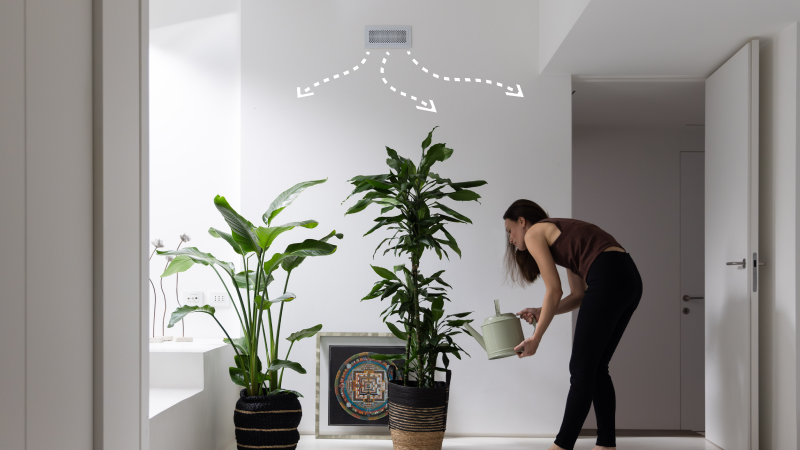
Controlled mechanical ventilation becomes particularly useful when problems are not occasional, but recurring.
It is often the most effective solution in the presence of:
-
rooms prone to mould formation;
-
frequent condensation on windows and walls;
-
stale or unhealthy air;
-
rooms with poor natural ventilation;
-
highly insulated homes;
-
high energy-efficiency renovations.
In these cases, the problem is not only humidity itself, but the fact that indoor air is not being exchanged correctly.
This is precisely where controlled mechanical ventilation makes the difference: it does not simply reduce the effects of the problem, but acts directly on the causes, improving air exchange and the internal balance of the rooms.
The advantages of controlled mechanical ventilation
Controlled mechanical ventilation offers benefits that go beyond simple humidity control.
The main advantages include:
-
continuous air exchange, without having to constantly open the windows;
-
reduction of the risk of mould and condensation;
-
filtration of incoming air;
-
greater home comfort and indoor air quality;
-
better energy efficiency in systems with heat recovery.
Aspects to consider before installation
Before installing controlled mechanical ventilation, it is important to consider some practical aspects.
The main ones include:
-
initial system cost;
-
any work required for installation;
-
choice between centralised and single-room/decentralised systems.
Controlled mechanical ventilation or dehumidifier against mould: which works better?
In most cases, mould forms due to a combination of:
-
high humidity;
-
poor ventilation;
-
persistent condensation on cold surfaces.
For this reason, simply reducing humidity is not always enough.
A dehumidifier can be useful for quickly lowering the level of humidity in the air.
Controlled mechanical ventilation, on the other hand, addresses the problem differently, continuously replacing the air inside the room with outdoor air. Thanks to continuous air exchange, it:
-
reduces humidity build-up;
-
improves indoor air quality;
-
limits the conditions that encourage mould formation.
For this reason, in the presence of stagnant air or poor air exchange, controlled mechanical ventilation can be an effective long-term solution, because it promotes continuous indoor air renewal.
In the case of recurring mould or persistent condensation, however, it is important to first assess the causes of the problem, which may depend on several factors: insulation, thermal bridges, ventilation habits, indoor humidity levels or the characteristics of the building.
Energy consumption: controlled mechanical ventilation and dehumidifier compared
Energy consumption is also an important aspect when choosing between controlled mechanical ventilation and a dehumidifier.
A dehumidifier, if used often or for many hours a day, can have a significant impact on electricity consumption, especially when used as a continuous solution.
A modern high-efficiency controlled mechanical ventilation system, on the other hand, is designed to operate constantly but with low consumption. In systems with heat recovery, the advantage is twofold: air is renewed without unnecessarily losing the heat already present in the home.
In summary:
-
the dehumidifier may consume more if used frequently;
-
controlled mechanical ventilation works continuously and more efficiently;
-
heat recovery helps reduce heat loss and improve the overall efficiency of the home.
How to understand which solution is best suited to your home
The choice between a dehumidifier and controlled mechanical ventilation depends above all on the type of problem you want to solve.
-
If the main issue is excess humidity, for example during certain periods of the year or when drying laundry indoors, a dehumidifier may be sufficient.
-
If, on the other hand, the goal is to renew indoor air and reduce the feeling of stale or stagnant air, controlled mechanical ventilation is a more suitable solution, because it promotes continuous and controlled air exchange.
-
If the air feels stale or unhealthy, simply controlling humidity may not be enough: the continuous air exchange provided by controlled mechanical ventilation improves indoor comfort in a more complete way.
-
If your goal is a general improvement in comfort and energy efficiency, especially in a modern and well-insulated home, an integrated solution can offer more stable results over time.


