
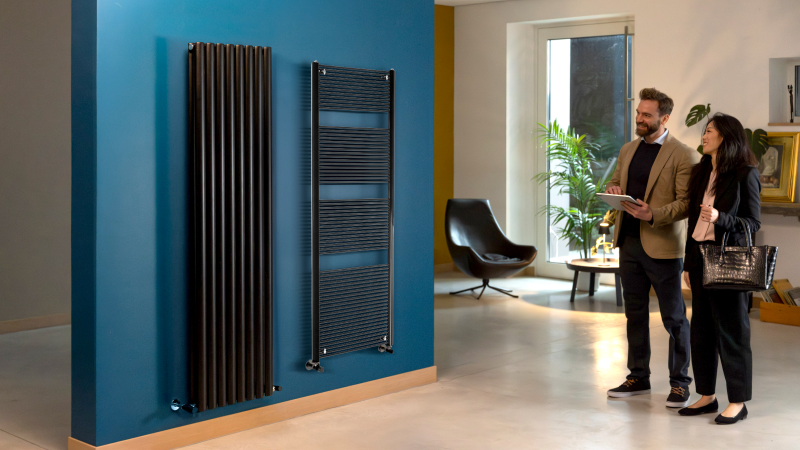
Are towel radiators and heated towel rails the same thing or not? It’s a very common question, especially when designing or renovating a bathroom.
These two elements are often considered interchangeable, but in reality they differ in terms of function, performance and intended use. Understanding these differences is essential in order to make a truly informed choice.
In this article, we’ll look in detail at:
- the main differences between towel radiators and heated towel rails;
- when it is better to choose one over the other;
- which aspects to consider in order to identify the most suitable solution for your needs.
Difference between a towel radiator and a heated towel rail
The difference between a towel radiator and a heated towel rail is simpler than it may seem.
A towel radiator is a radiator designed to heat living spaces, while a heated towel rail is a specific type of radiator mainly designed for bathrooms and for drying towels.
Although they may look similar aesthetically, they are created for different purposes and offer different performances.
Here is a direct comparison to clarify the differences:
- Main function
- Towel radiator: heating the room
- Heated towel rail: drying and warming towels (while also contributing to room heating)
- Rooms of installation
- Towel radiator: throughout the home (living room, bedrooms, hallway, bathroom)
- Heated towel rail: mainly bathrooms
- Heating output
- Towel radiator: generally higher output, suitable for heating medium and large rooms
- Heated towel rail: lower output, ideal for smaller spaces or supplementary heating
- Design
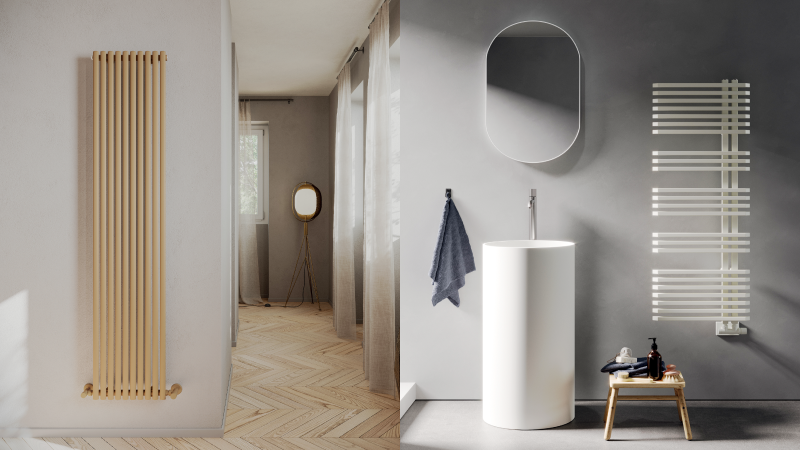
- Towel radiator: wide variety of shapes, materials and finishes, with strong aesthetic value
- Heated towel rail: more functional structure (often ladder-style), designed for hanging towels
What is a towel radiator and what is it used for?
A towel radiator is the evolution of the traditional radiator: a heating element that combines functionality and design, transforming a technical component into a true furnishing feature.
It does not simply heat a room, but also contributes to the overall style of the space thanks to increasingly refined shapes, materials and finishes.
From a functional perspective, a towel radiator can be used in two ways:
- as the main heating system, sized to provide thermal comfort for the room;
- as a supplementary heating element, supporting other systems already in place.
Contrary to popular belief, it is not designed exclusively for bathrooms. A towel radiator can be installed in different areas of the home, such as living rooms, bedrooms or hallways, adapting to both aesthetic and performance requirements.
To explore the available solutions, you can consult the complete range here.
What is a heated towel rail and what is it used for?
A heated towel rail is a radiator mainly designed for bathrooms, combining practicality and comfort in a single solution.
Its distinctive feature is its dual function:
- heating the room and contributing to bathroom comfort;
- drying and warming towels, keeping them ready for use at all times.
For this reason, it often features a horizontal bar structure, ideal for hanging towels and bathrobes.
The main differences between towel radiators and heated towel rails
Function and intended use
A towel radiator is designed to heat the room effectively, while a heated towel rail has a more targeted purpose: drying and warming towels while contributing to bathroom comfort.
Installation areas
A towel radiator is versatile and can be installed in different areas of the home, from living rooms to sleeping areas. A heated towel rail, on the other hand, is designed almost exclusively for bathrooms.
Output and thermal performance
Towel radiators generally provide higher heat output, suitable even for medium and large rooms. Heated towel rails usually have lower output and are ideal for small spaces or as supplementary heating.
Design and aesthetic impact
A towel radiator has strong decorative value, with shapes, materials and finishes that make it a true furnishing feature. Heated towel rails, instead, prioritise more functional design linked to practicality.
Structure and shape
A towel radiator can take on many different configurations, including minimalist or sculptural designs. Heated towel rails typically feature a ladder-style structure, designed for easily hanging towels and bathrobes.
Towel radiator or heated towel rail: which should you choose?
A towel radiator is the right choice when:
- you want to heat the room effectively, even in larger spaces;
- you are looking for a solution that combines performance and design;
- you want a heating element that becomes a feature of the room and contributes to the overall interior style.
A heated towel rail is more suitable when:
- you have a small bathroom;
- your needs are mainly practical and functional;
- you need supplementary heating in addition to towel drying.
How to correctly size a towel radiator or heated towel rail
Choosing the right model is not just about aesthetics and function: it is essential to correctly size the heating output according to the characteristics of the room.
The main factors to consider are:
- room size in square metres;
- ceiling height (and therefore total room volume);
- insulation level of the building (windows, walls, exposure).
As a general guideline:
- well-insulated rooms: approximately 60-80 W per m²;
- moderately insulated rooms: 80-100 W per m²;
- poorly insulated rooms: 100-120 W per m².
In the case of heated towel rails, output is often lower because they are commonly used as supplementary heating. However, if they are expected to significantly contribute to heating the bathroom, it is important not to undersize them.
You can calculate the heating requirement of your room with our dedicated configurator!
Electric or hydronic: which is better?
The choice between electric and hydronic mainly depends on the existing heating system and intended use.
Choose an electric towel radiator or heated towel rail if:
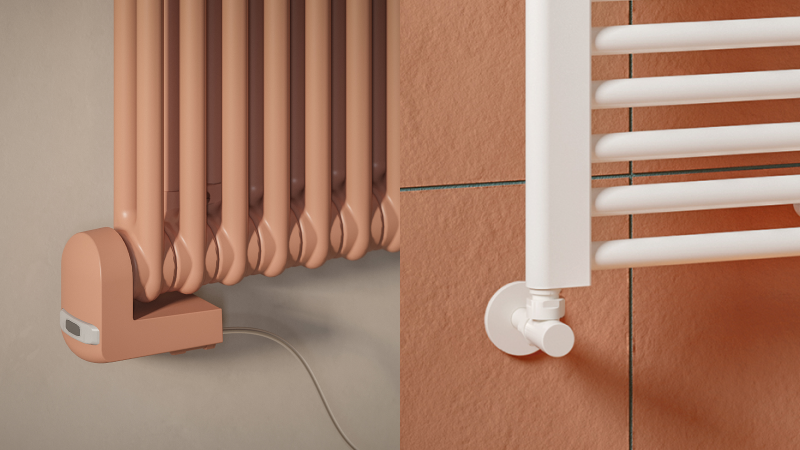
- you want to avoid building work: it is a plug & play solution requiring no hydraulic connections;
- you need fast heat only when necessary;
- you already have underfloor heating and want a more responsive supplementary solution;
- you want smart features such as programming, remote control or app management.
Choose a hydronic towel radiator or heated towel rail if:
- you already have a radiator-based heating system and want to replace an existing radiator;
- you are looking for an efficient solution for continuous operation.
The alternative: hybrid operation
If you want the best of both worlds, you can choose a hybrid system: it works with hot water during winter and electrically when the heating system is switched off, ensuring year-round comfort.
From a technical point of view, hybrid operation combines hydronic and electric heating within the same towel radiator. During installation, an electric heating element is inserted into one of the radiator’s vertical manifolds.
This means:
- when the heating system is operating, the towel radiator works normally with hot water;
- when the heat generator is switched off, it can operate independently using the electric element.
This allows the towel radiator to remain usable at all times, for example to heat the bathroom or dry towels even during spring and autumn.
IRSAP towel radiators: design and performance for every space
IRSAP offers towel radiators designed to:
- integrate perfectly into every room of the home;
- guarantee reliable long-term performance;
- enhance spaces with distinctive design.
Whether you need to heat a bathroom, living room or bedroom area, it is possible to find the right solution by combining technical performance and aesthetics.
For more information, visit the dedicated IRSAP towel radiator page.


