
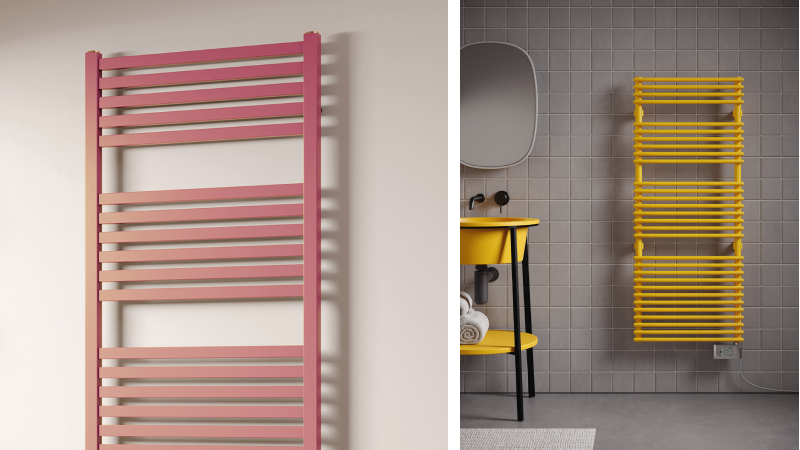
Before choosing a heated towel rail, it is important to understand that it is not just a furnishing element. Especially in the bathroom, a heated towel rail is designed to heat the room, increase daily comfort and keep towels and bathrobes dry.
For this reason, design, dimensions and finishes are not the only aspects that matter when choosing one: the type of power supply is also important, as it affects operation, installation and practicality of use.
The most common question is therefore: is an electric or hydraulic heated towel rail better? There is no one-size-fits-all answer. The most suitable solution depends on the system already present in the home, how frequently the bathroom is used, energy consumption, ease of installation and the desired level of autonomy.
In this article, we will compare both solutions, analysing how they work, their advantages and their limitations, while also considering a third alternative: the dual-fuel heated towel rail, which combines the strengths of electric and hydraulic systems.
What a heated towel rail is and what it is used for in the bathroom
A heated towel rail is a radiator designed to combine heating performance and aesthetics. Unlike traditional radiators, it is created to integrate with the interior design and enhance the space, without compromising on performance.
In the bathroom, it is often also used as a towel warmer, thanks to its structure that allows towels, bath sheets and bathrobes to be placed or hung on it, keeping them dry and pleasantly warm.
Although the terms “heated towel rail” and “towel warmer” are often used interchangeably, a heated towel rail performs a broader function: in addition to drying fabrics, it contributes to heating the entire room, improving everyday comfort.
Electric or hydraulic heated towel rail: what is the main difference?
The main difference concerns the way heat is produced.
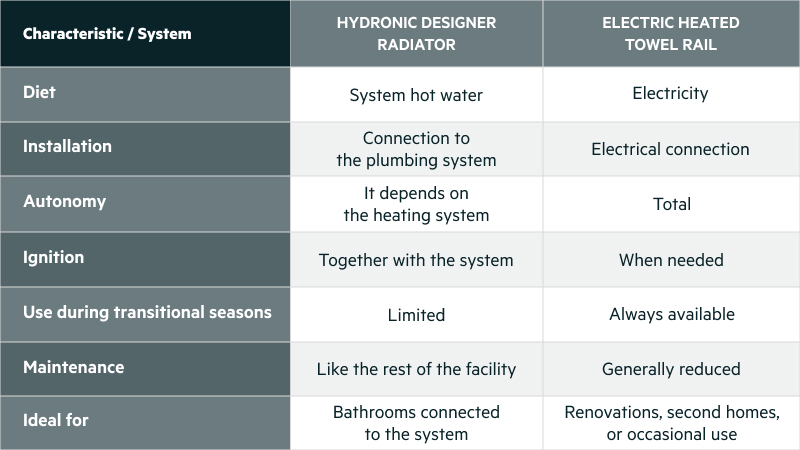
A hydraulic heated towel rail is connected to the home heating system and works using hot water from the boiler, heat pump or another heat generator.
An electric heated towel rail, on the other hand, is completely independent and produces heat through an element powered by the electrical mains.
How a hydraulic heated towel rail works
A hydraulic heated towel rail works exactly like a normal radiator: hot water produced by the heating system circulates inside it, heating the surface of the heating body and transferring heat to the room.
This solution is particularly suitable when the bathroom is already connected to the hydraulic system or during a new build or renovation, where the system can be designed from the outset.
It is important to remember that its operation is generally linked to that of the central system: if the heating is switched off, the heated towel rail does not produce heat either, except in the case of dual-fuel models.
When to choose a hydraulic heated towel rail
A hydraulic heated towel rail is often the best choice when a heating system is already present and you want to heat the bathroom together with the other rooms in the home.
It is particularly suitable for those who:
-
already have hydraulic connections in place;
-
use the bathroom at the same times as the heating is on;
-
are looking for a stable solution integrated into the home system;
-
want uniform comfort throughout the winter season.
Advantages of a hydraulic heated towel rail
One of its main strengths is its perfect integration with the existing heating system, which makes it possible to heat the bathroom together with the rest of the home without requiring separate systems.
If the system is well designed, the heated towel rail provides constant and uniform heat, contributing to everyday comfort and making efficient use of the available heat source.
In addition, there is a wide range of options to choose from: today, hydraulic heated towel rails are available in numerous shapes, colours and finishes, and are true design elements that can enhance bathroom interiors as well as perform their heating function.
Limitations of a hydraulic heated towel rail
The main limitation is its dependence on the heating system.
When the boiler or centralised system is switched off, the heated towel rail cannot be used independently. This can be impractical in the mid-seasons, when you simply want to dry towels or heat the bathroom for a few minutes without activating the entire system.
Another aspect to consider is installation: if hydraulic connections are not already present in the desired position, work on the pipes or walls may be required, with generally longer times and higher costs than installing an electric model.
How an electric heated towel rail works
Unlike the hydraulic model, an electric heated towel rail is not connected to the home heating system, but works using electricity.
Inside, there is an electric element that heats the fluid contained in the radiator or directly heats the heating body, allowing the heated towel rail to produce heat completely independently.
Its main strength is precisely this independence: it can be switched on when needed, even if the boiler or heating system is off. For this reason, it is a highly appreciated solution in the mid-seasons or when you want to heat the bathroom only for short periods.
Since it is electrically powered, however, it is important to consider that its use directly affects energy consumption and should be assessed according to how often it will be used.
When to choose an electric heated towel rail
An electric heated towel rail is particularly suitable when there are no hydraulic connections in place or when you want to avoid invasive work on the existing system.
It can be the ideal solution, for example, for:
-
a secondary bathroom used only occasionally;
-
a holiday home;
-
a light renovation;
-
those who want warm towels even in spring or autumn;
-
apartments where work on the pipework is not desired.
It is also an interesting choice when you want to increase bathroom comfort without modifying the heating system of the entire home.
Advantages of an electric heated towel rail
The main advantage is its complete operating autonomy. The heated towel rail can be switched on only when needed, independently of the rest of the system.
This is combined with other benefits:
-
generally simpler installation;
-
independent temperature management;
-
possibility of programming switch-on and switch-off times;
-
greater practicality in the mid-seasons.
The most advanced models also integrate thermostats and programming systems, allowing the heated towel rail to be used only when it is actually needed.
If used in a targeted way, for example for an hour before taking a shower or in the morning, an electric heated towel rail is a very practical solution. Continuous use for many hours, however, may result in higher electricity consumption.
Limitations of an electric heated towel rail
The main limitation concerns the cost of electricity.
Consumption depends on several factors:
-
power output of the heated towel rail;
-
usage time;
-
set temperature;
-
bathroom insulation;
-
presence of control and programming systems.
It is also important to remember that, as an electrical appliance installed in the bathroom, it must comply with the safety standards required for humid environments. For this reason, it is always advisable to rely on a qualified professional for installation, who will be able to identify the correct position in relation to the shower, bathtub and other areas exposed to water.
Electric or hydraulic heated towel rail: comparison of consumption and costs
One of the most frequently asked questions is: which solution consumes less?
In reality, there is no one-size-fits-all answer, because the result depends on numerous factors: the type of system, the cost of energy, frequency of use and the efficiency of the home.
A hydraulic heated towel rail can be particularly cost-effective when it is part of an already active and efficient heating system, using the home’s heat generator.
An electric heated towel rail, on the other hand, uses electricity directly, but can be a rational choice when it is switched on only when it is actually needed.
Installation costs
From an installation point of view, an electric heated towel rail is generally easier to integrate, especially if a suitable power supply point is already available.
The hydraulic model, on the other hand, may require work on the pipes and system connections, especially when the bathroom has not already been prepared for this.
During a complete renovation, however, this difference tends to decrease, because the systems are usually modified anyway.
Running costs
An electric heated towel rail switched on for half an hour or an hour a day to increase bathroom comfort will have a very different impact compared to continuous operation for several hours.
A hydraulic heated towel rail, on the other hand, contributes to the overall consumption of the heating system and is generally more cost-effective when the system is already running to heat the entire home.
Maintenance and durability over time
Both solutions can offer a long service life, provided they are installed correctly and used according to the manufacturer’s instructions.
A hydraulic heated towel rail requires the normal maintenance operations of the heating system, such as checking the valves, bleeding any air and verifying correct operation.
An electric heated towel rail, on the other hand, does not require hydraulic maintenance, but it is important that the electrical system is installed to professional standards and that the device is installed and used in compliance with safety regulations.
With quality products and correct installation, both electric and hydraulic models can guarantee reliability and performance for many years.
Is an electric or hydraulic heated towel rail better?
The choice depends above all on how you use the bathroom and on the type of system already present in the home.
In general, a hydraulic heated towel rail is the most suitable solution when you want to integrate the bathroom into the main heating system, while an electric heated towel rail offers greater autonomy and is perfect for occasional or off-season use.
Here are some practical scenarios that can help you identify the most suitable solution.
If you are renovating the bathroom
If the renovation also includes work on the systems, a hydraulic heated towel rail is often the most natural choice. You can easily integrate it into the home heating system and achieve uniform comfort throughout the winter season.
If, on the other hand, it is a light renovation and you do not want to work on the pipework, an electric model may be much easier to install.
If you want to use the heated towel rail even when the heating is off
If you want warm towels or a comfortable bathroom even in the mid-seasons, an electric heated towel rail is generally the most practical solution.
It can be switched on only when needed, without having to activate the entire heating system.
If you are looking for the most efficient solution for daily use
If you use the bathroom at the same times as the home heating is normally on, a hydraulic heated towel rail is often the most efficient choice, because it uses the system that is already running and guarantees constant heat.
If, on the other hand, your needs change frequently throughout the year, it may also be worth considering a dual-fuel solution.
Dual-fuel heated towel rail: when it may be the best solution
A dual-fuel heated towel rail combines the advantages of the two technologies.
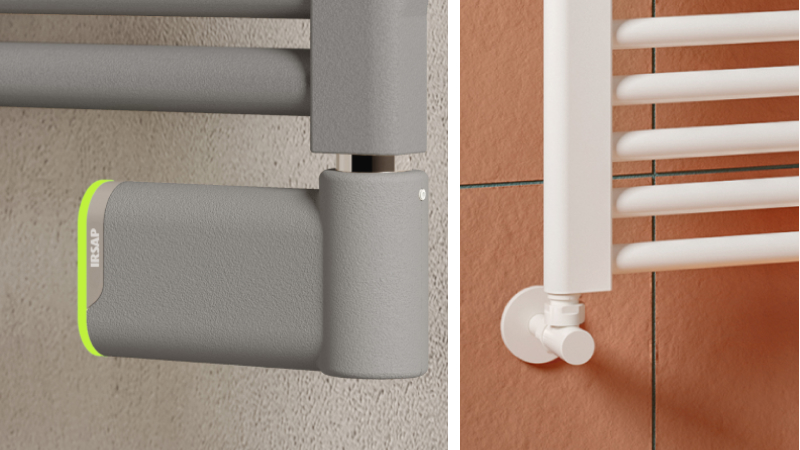
It is connected to the hydraulic system like a normal radiator, but also integrates an electric element, which allows it to be used independently when the central heating is off.
During winter, it works like a hydraulic heated towel rail, while in the mid-seasons it can be operated in electric mode to heat the bathroom or dry towels without activating the entire system.
For this reason, it is a particularly popular solution in bathrooms, where the need for heat is often limited to specific moments of the day.
Advantages of a dual-fuel heated towel rail
The main advantage is maximum flexibility of use.
It allows you to benefit from the efficiency of the heating system during winter, while at the same time maintaining the freedom to use the heated towel rail independently when needed.
It can also be an interesting solution for those who live in an apartment building with centralised heating or want greater autonomy during periods when the system is not running.
When to consider a dual-fuel solution
A dual-fuel heated towel rail may be the ideal choice when:
-
the bathroom is used frequently throughout the year;
-
you want warm towels even out of season;
-
the main heating remains off for many hours;
-
you are looking for a good balance between efficiency and practicality.
Can a hydraulic heated towel rail be converted into an electric one?
In some cases, yes.
There are electric elements and dedicated kits that allow some hydraulic heated towel rails to be adapted, making them usable in electric mode as well.
However, feasibility depends on the radiator model, its construction characteristics and the existing system.
This is not a job to improvise: as it involves both hydraulic and electrical components, it is always advisable to contact a qualified installer, who can check compatibility and recommend the safest solution.
When conversion may make sense
Adaptation can be considered when you want to:
-
use the towel warmer even when the system is off;
-
increase the flexibility of use of the bathroom;
-
improve comfort without completely replacing the existing heated towel rail.
When it is better to choose a new model directly
If the heated towel rail is dated, inefficient, incompatible with an electric element or no longer suitable for the bathroom’s requirements, it is often better to choose a new electric, hydraulic or dual-fuel model directly.
In this way, you get a solution designed from the outset for the desired type of use, with better performance and greater reliability.

How to choose the right heated towel rail for your bathroom
The choice does not depend only on the type of power supply. To find the most suitable model, it is also important to assess the size of the bathroom, the required output, the available space and how it will be used.
Assessing the required output
Like any radiator, a heated towel rail must also be correctly sized.
A model that is too small may not be able to heat the bathroom adequately, while one that is excessively powerful may be disproportionate to the space and actual needs.
To explore the topic in more detail, you can consult the dedicated guide to radiator sizing.
Considering the available space
The bathroom is often one of the rooms with the least free wall space.
Before choosing, it is therefore important to assess:
-
position of sanitary ware, shower and bathtub;
-
doors and windows;
-
bathroom furniture;
-
available wall surface.
In many cases, vertical heated towel rails, compact towel warmers or design models make it possible to use the space more effectively without compromising on performance.
Choosing based on usage habits
Daily habits have a major influence on the choice.
If the bathroom is mainly used when the home heating is already on, a hydraulic heated towel rail may be more than sufficient.
If, on the other hand, you want to switch it on only in the morning, in the evening or during the mid-seasons, an electric or dual-fuel model offers greater freedom of use.
Assessing aesthetics, colours and finishes
A heated towel rail is a highly visible element and contributes to the aesthetics of the bathroom just as much as other furnishing accessories.
Once the most suitable type has been identified, it is possible to choose from numerous solutions in terms of shape, size, colours and finishes, so as to perfectly integrate the radiator into the style of the room.
Today’s most modern heated towel rails make it possible to combine design, comfort and functionality, transforming a simple heating element into a true furnishing accessory.
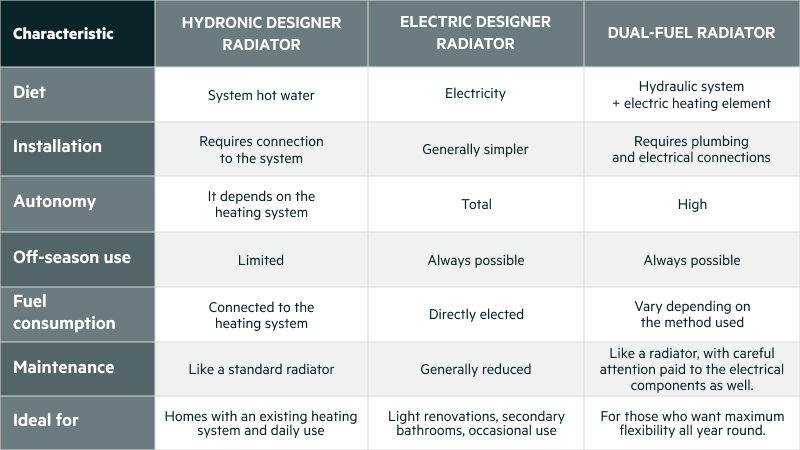
Electric, hydraulic or dual-fuel heated towel rail: summary table
To help you quickly compare the three solutions, here is a summary of the main features.
IRSAP solutions for bathroom heated towel rails
IRSAP offers a wide range of heated towel rails and towel warmers designed to meet different needs in terms of comfort, aesthetics and functionality, with solutions suitable for both new builds and renovation projects.
The choice of model should not stop at the distinction between electric, hydraulic or dual-fuel, but should also consider other key aspects, such as:
-
the output required to heat the bathroom;
-
dimensions and available space;
-
design and finishes;
-
compatibility with the existing heating system.
To explore the different solutions in more detail, you can consult the IRSAP towel warmer range.
If, on the other hand, you are considering a completely independent solution, you can discover the IRSAP electric radiator collection.
Thanks to the wide availability of models, sizes and finishes, it is possible to identify a heated towel rail that combines performance, practicality and design, enhancing the bathroom without compromising on everyday comfort.


