

Modern homes are becoming increasingly well-insulated from a thermal perspective. While this offers a massive advantage for energy efficiency, it also has a downside: natural air exchange inside the rooms is significantly reduced.
The result? Moisture, stale air, condensation, and, in the worst cases, mould.
This is where a forced ventilation system comes into play, often referred to as Controlled Mechanical Ventilation (CMV). In this guide, we will explore how a forced ventilation system works, the different types available, and when it is best to install one.
What is a forced ventilation system?
A forced ventilation system is designed to guarantee a continuous exchange of air within enclosed spaces. Its goal is simple: to extract stale indoor air and introduce fresh, filtered outdoor air, thereby improving:
-
Indoor air quality
-
Humidity levels
-
Living comfort
-
Energy efficiency
How a forced ventilation system works
The system operates on a continuous cycle:
-
Indoor air, loaded with moisture and pollutants, is extracted.
-
Simultaneously, fresh air from the outside is introduced.
In more advanced systems, the incoming air passes through filters that capture dust and impurities.
Another key element is heat recovery: many modern systems recover heat from the extracted air during winter to preheat the incoming fresh air, while doing the reverse in summer. This improves comfort without wasting energy.
How air exchange takes place
Air is typically extracted from rooms where moisture and odours tend to accumulate, such as:
-
Bathrooms
-
Kitchens
-
Laundry rooms
Fresh replacement air is then supplied to the "primary" living spaces where we spend most of our time:
-
Living rooms
-
Bedrooms
-
Studies/home offices
This creates a continuous airflow that keeps the air cleaner throughout the entire home.
The role of the heat exchanger
In winter, its job is to transfer heat from the warm outgoing air to the cool incoming air, without mixing the two streams. In summer, it does the opposite, making the incoming air cooler.
The benefits are clear:
-
Reduced thermal dispersion
-
Higher energy efficiency
-
Enhanced indoor comfort
The difference between natural and forced ventilation
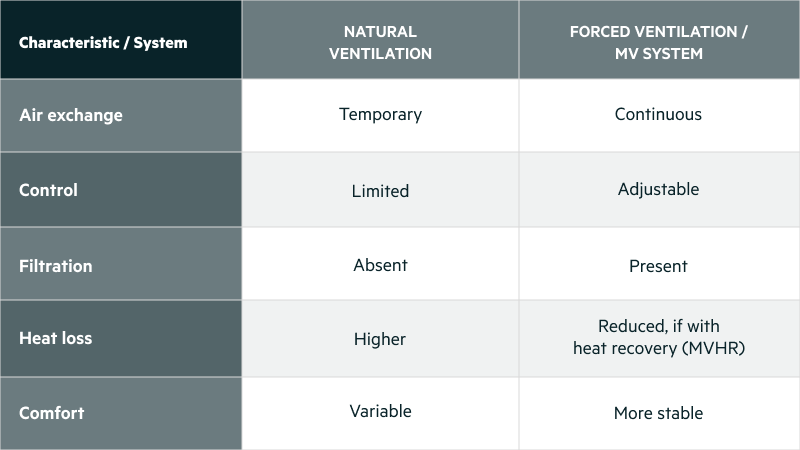
Natural ventilation happens simply by opening windows to let outdoor air in. While straightforward and immediate, it has a major limitation: the air exchange is temporary, uncontrolled, and intermittent.
Forced ventilation, on the other hand, guarantees a continuous and controlled air exchange. This allows spaces to be properly ventilated without relying solely on daily habits.
Types of forced ventilation systems
There are various solutions available, to be chosen based on the building type, available space, and comfort and efficiency goals.
Centralised CMV systems
A centralised CMV system manages air exchange for the entire home through a main ventilation unit and a distribution network consisting primarily of ducting and air vents.
It is often the ideal solution for:
-
New builds
-
Major renovations
-
Homes requiring a complete, integrated system
Decentralised or single-room CMV systems
A single-room CMV system works on individual rooms without an extensive ductwork network.
It is ideal when:
-
Targeting a specific room
-
Working with an existing building
-
Looking for a less invasive solution
It requires minimal structural work and is often easier to install.
Forced ventilation with heat recovery
Solutions with heat recovery allow spaces to be ventilated while minimizing energy losses.
In winter, the system recovers part of the heat from the extracted air and uses it to preheat the incoming air, while doing the opposite in summer. This improves:
-
Indoor comfort
-
Energy efficiency
-
Air quality
To learn more about this topic, you can browse our dedicated pages on double-flow ventilation systems.
What are the benefits of forced ventilation?
A forced ventilation system concretely improves comfort and quality of life at home. Specifically, it delivers:
Better indoor air quality
The system continuously helps eliminate:
-
Stale air
-
Excess humidity
-
Persistent odours
-
Indoor pollutants
Additionally, thanks to the filters, the air introduced from the outside is cleaner and controlled.
Reduction of mould and condensation
Mould and condensation are often linked to excess moisture and insufficient air exchange. Forced ventilation helps keep humidity stable, reducing the conditions that promote:
-
Condensation forming on windows and walls
-
Mould appearing in corners or colder areas of the house
Greater energy efficiency
In systems with heat recovery, air is exchanged while limiting thermal dispersion. This means:
-
The house remains well-ventilated
-
Less heat is lost compared to continuously opening windows
-
Heating in winter and air conditioning in summer work more efficiently
Year-round living comfort
One of the most noticeable benefits is daily comfort. Constant air exchange creates environments that are:
-
Less humid
-
Healthier
-
Filled with fresher, lighter air
The overall feeling is that of a more balanced, pleasant home to live in during every season.
Where to install a forced ventilation system
A forced ventilation system can be installed in many different residential contexts. It is particularly useful in:
-
Highly insulated buildings and/or those with poor natural ventilation
-
Renovated buildings
-
Spaces prone to moisture and mould
The choice of solution also depends on the type of project. In new builds, it is easier to integrate complete centralised systems, whereas in renovations or existing buildings, single-room or decentralised solutions are often preferred because they are less invasive to install.
What to consider before installation
Before choosing a forced ventilation system, it is important to consider a few practical aspects. The most suitable solution depends on:
-
Home size
-
Insulation level
-
Number of rooms
-
Available space
-
Budget
Vents, ductwork, and available space
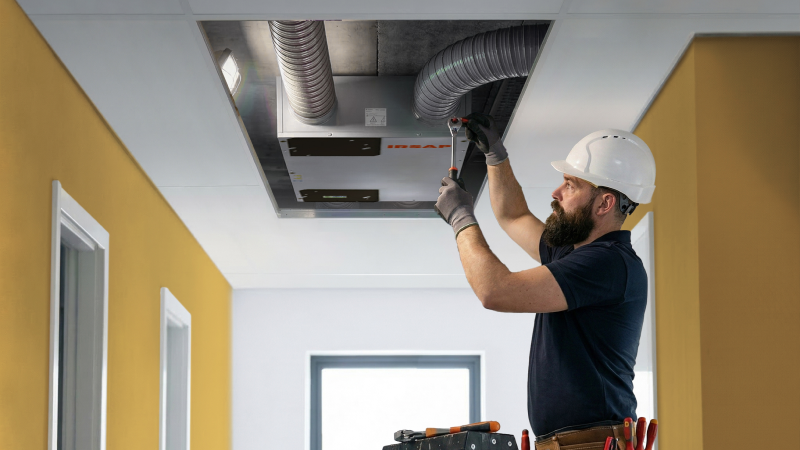
One of the main aspects concerns the space required for installation. Centralised systems require:
-
Ducting
-
Suspended ceilings or technical spaces
-
Supply and extract grilles/vents
Single-room solutions, however, require minimal intervention and are often easier to integrate into existing buildings.
Noise levels and maintenance
Quiet operation is essential, especially in domestic environments. A good system must guarantee:
-
Discreet operation
-
Acoustic comfort
-
Easy maintenance
It is also vital to factor in the periodic cleaning and replacement of filters, which are necessary to keep the system efficient and ensure good air quality over time.
How much does a forced ventilation system cost?
The cost of a forced ventilation system can vary greatly depending on the chosen type and the complexity of the installation.
In general:
-
Single-room or decentralised systems require smaller investments and less invasive work.
-
Centralised systems have higher costs because they involve ductwork, dedicated design, and more structural work.
The price is also influenced by:
-
The size of the home
-
The number of rooms involved
-
The insulation level
-
The complexity of the installation works
Are there incentives available for installing this type of system?
In some cases, yes. The installation of a forced ventilation system may qualify under energy efficiency improvement or home renovation schemes, providing access to tax incentives.
Availability depends on the specific work carried out and the regulations in force at the time of the project. Therefore, it is always advisable to check current guidelines before installing.
How to keep a forced ventilation system efficient
To guarantee high performance over time, the system requires regular maintenance. Proper upkeep helps maintain:
-
Indoor air quality
-
Energy efficiency
-
System lifespan
Cleaning and replacing filters
Filters trap dust and impurities present in the air. For this reason, they must be:
-
Periodically checked
-
Cleaned or replaced when necessary
Dirty filters reduce system efficiency and degrade air quality.
Periodic system checks
It is useful to carry out regular checks to verify the correct operation of:
-
Fans
-
Vents/grilles
-
Ductwork
-
Heat exchanger
Consistent maintenance prevents performance drops and ensures more efficient operation over time.
IRSAP solutions for comfort and air quality
Improving indoor air quality means creating a balance between ventilation, thermal comfort, and energy efficiency.
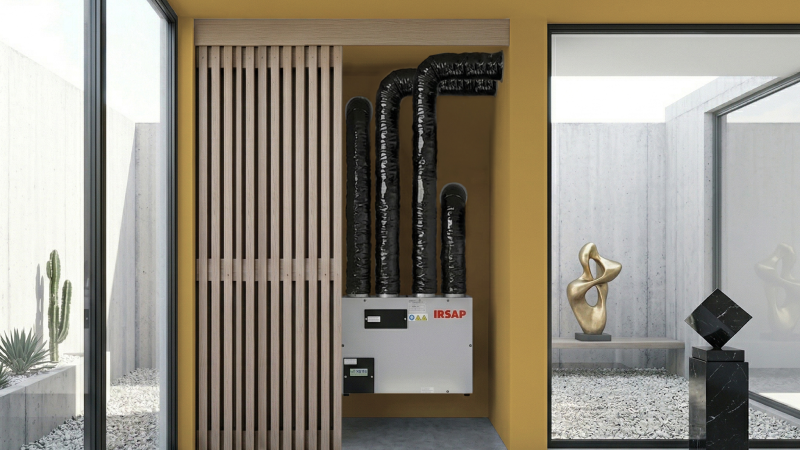
IRSAP air treatment solutions are specifically designed to help maintain healthier environments by controlling humidity, air exchange, and indoor well-being.
You can learn more about our dedicated air quality solutions in the IRSAP AIR section and discover our controlled mechanical ventilation systems.
Frequently Asked Questions about forced ventilation systems
Are forced ventilation and CMV the same thing?
No, forced ventilation and CMV are not exactly the same thing, although they are often confused.
"Forced ventilation" is a broad term that generally refers to any mechanically driven air exchange. CMV (Controlled Mechanical Ventilation), however, is a more advanced and specific system: it ensures a constant, automated air exchange, filters the incoming air, and—in systems with heat recovery—limits energy losses by recovering heat from the extracted air. This makes it a solution designed not just to solve a problem, but to prevent it, improving comfort, air quality, and home efficiency.
Does a forced ventilation system consume a lot of energy?
A basic forced ventilation system, such as a simple extractor fan, may have low electricity consumption, but the real issue is thermal waste: in winter, by expelling warm air outside, it forces the heating system to work harder to bring the room back to temperature (and the reverse happens in summer).
A CMV system with heat recovery is designed to reduce this waste: thanks to the heat exchanger, it recovers part of the heat from the outgoing air and introduces fresh air that is already pre-warmed. Because of this, it guarantees air exchange much more efficiently and with a lower impact on the home's overall energy consumption.
Can CMV be installed in an existing home?
Yes, CMV can be installed in an existing home, especially during renovations or energy efficiency upgrades, such as the installation of external wall insulation (thermal coat).
When a home is better insulated, it reduces natural draughts but traps moisture and pollutants more easily. CMV allows for a constant and controlled air exchange, helping to prevent mould and condensation without unnecessarily wasting heat.
How much does a forced ventilation system cost?
The cost depends on the type of solution chosen and the complexity of the project. Indicatively, prices can start from around €300 for single-room solutions in a specific space, up to €5,000 - €15,000 (installation included) for a fully ducted system capable of serving the entire home.
Does forced ventilation help against mould and humidity?
Yes, forced ventilation helps against mould and humidity, but its effectiveness depends on the system.
A single-room CMV unit can be useful for reducing humidity in a specific room where the problem is already present. A centralised CMV system, however, is the right solution when the goal is to treat the entire home, ensuring a constant and controlled air exchange that prevents stagnant moisture, condensation, and mould formation, especially in well-insulated or newly renovated houses.
How often should CMV filters be changed?
CMV filters trap pollutants from the outside air and are essential for keeping the system efficient and ensuring clean air in the home.
In general, it is advisable to check them every 3 to 6 months and replace them at least twice a year. However, more frequent replacement may be required in highly polluted areas. Since precise timelines vary depending on the model, it is always best to refer to the user manual or the installer's guidelines.


