

The thermostat has a direct impact on energy consumption and, consequently, on heating bills. However, it is often used inefficiently: temperatures that are too high, non-optimised schedules or constant adjustments can increase consumption without truly improving comfort.
The good news is that, in most cases, you do not need to raise the temperature significantly to feel comfortable at home. In fact, even small adjustments can make a real difference.
In general, it is estimated that every degree less can reduce consumption by up to around 10%. This means that learning how to set the thermostat correctly can help save energy without giving up everyday well-being.
In this guide, we will look at:
-
which temperature to set;
-
how to manage schedules and programming;
-
which mistakes to avoid in order to consume less while maintaining comfort at home.
Why the thermostat is essential for saving energy
The thermostat is the device that regulates the operation of the heating system based on the desired temperature.
Its role is not simply to switch radiators on or off, but to manage heat more efficiently.
An important aspect is temperature stability. Continuous temperature fluctuations, for example switching the heating off completely and then quickly bringing the house back to high temperatures, can increase consumption because the system has to work harder to recover the lost heat.
For this reason, in most cases, it is more efficient to maintain a moderate but constant temperature throughout the day.
What is the ideal thermostat temperature to save energy?
In general, the recommended temperatures are:
-
19-20°C during the day, when you are at home;
-
16-17°C during the night or during prolonged absences.
Exceeding these thresholds does not necessarily mean feeling more comfortable. On the contrary, rooms that are too warm can feel less comfortable, drier and significantly increase energy consumption.
Ideal daytime temperature
During the hours spent at home, keeping the thermostat around 19-20°C is generally sufficient to ensure comfort.
A slightly cooler but stable environment often feels more pleasant and sustainable over time.
Ideal temperature at night or when you are not at home
At night or during absences, it is advisable to lower the temperature to 16-17°C, without switching the heating off completely.
In winter, in fact, allowing the home to cool down too much can lead to higher consumption, because the system will have to work harder to bring the rooms back to the desired temperature.
Is it better to switch the heating off or maintain a constant temperature?
In most cases, maintaining a slightly lower but constant temperature is more efficient than switching the heating off completely.
For example:
-
if you go out for a few hours, it is better to lower the thermostat to 16-17°C instead of switching everything off;
-
if the home remains unoccupied for several days, it may make sense to lower the temperature further or switch the system off, depending on the climate and the insulation of the building.
How to programme the thermostat to consume less
The general rule is simple: heating should follow the real daily habits of the home.
For example:
-
increase the temperature shortly before waking up;
-
reduce it during the hours when the home is empty;
-
bring it back to comfort levels before returning home.
In this way, you avoid unnecessarily heating empty rooms for many hours.
Managing time slots is also important:
-
programmes that are too long increase consumption;
-
switch-on periods that are too short or discontinuous can reduce comfort and create temperature fluctuations.
How many hours to keep the heating on
There is no number of hours that applies to every home. The ideal duration mainly depends on:
-
home insulation;
climate zone;
type of heating system.
For example, a well-insulated home retains heat for longer and may require shorter operating times than a home with greater heat loss.
The type of system also has an impact:
-
highly responsive systems can operate for shorter periods;
-
systems with greater thermal inertia work better with more stable and continuous temperatures.
How to set the thermostat when you are away from home
When you leave the house, the best strategy depends on how long you will be away.
For short absences, such as a few hours, it is advisable to:
-
lower the temperature by a few degrees;
-
keep the thermostat around 16-17°C.
In this way, you limit the cooling of the rooms without forcing the system to work too hard when you return.
For longer absences, it is possible to lower the temperature further or use dedicated modes, if available on the thermostat.
Difference between thermostat and programmable thermostat
A traditional thermostat simply allows you to set a temperature: when the room drops below the selected value, the heating is activated.
A programmable thermostat, on the other hand, adds a fundamental function: time scheduling.
This means that it is possible to:
-
set different temperatures throughout the day;
-
adapt heating to your habits;
-
automatically reduce the temperature when maximum comfort is not needed.
This is where real energy savings are achieved. A programmable system avoids unnecessary waste and allows heating to be managed in a smarter and more precise way.
Today, there are also intelligent solutions that allow app control, remote management and more advanced temperature regulation. You can explore intelligent regulation systems in the IRSAP NOW section and consult the IRSAP smart radiator range.
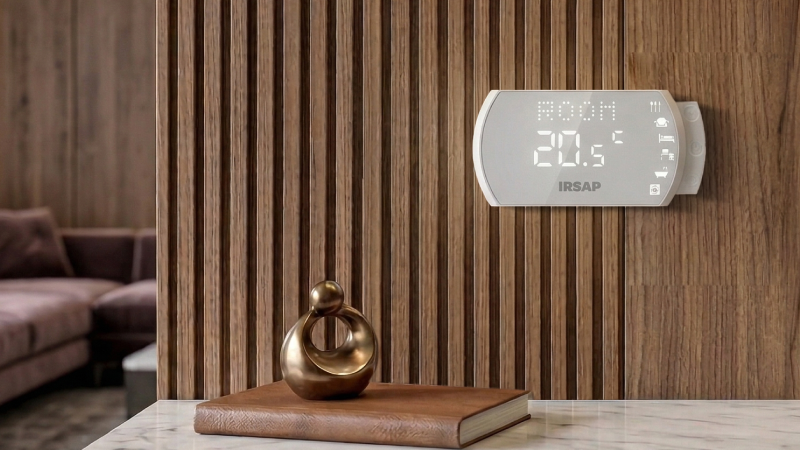
Where to position the thermostat to avoid waste
The positioning of the thermostat is very important because it directly affects the detection of indoor temperature.
If the device measures an incorrect temperature, the heating may switch on too often or too little, increasing consumption and reducing comfort.
For this reason, it is better to install the thermostat:
-
in a central area of the home;
-
at an intermediate height from the floor;
-
in a room that is representative of the general temperature of the home.
Thermostatic valves and thermostat: how to use them together
Thermostat and thermostatic valves work together, but they have different functions.
The thermostat manages the overall operation of the system, regulating the temperature of the home. Thermostatic valves, on the other hand, act on individual radiators and make it possible to control the temperature room by room.
In practice:
-
the thermostat defines “when” the system should heat;
-
the valves help decide “where” and “how much” heat to distribute in the different rooms.
You can learn more about how valves work in the article dedicated to radiator valves.
The main advantage is the reduction of energy waste. For example:
-
rarely used bedrooms can be kept at lower temperatures;
-
living rooms and main areas can have greater comfort only during the necessary time slots.
This more precise management improves comfort and efficiency, especially when integrated with advanced regulation systems.
To explore solutions dedicated to heating and intelligent temperature control in more detail, you can consult the IRSAP radiator range and IRSAP NOW systems.
The most common mistakes that increase heating bills
Very often, high consumption does not depend only on the system, but also on some inefficient habits.
The most frequent mistakes include:
-
Setting the temperature too high. Even a few extra degrees can significantly increase consumption without truly improving comfort.
-
Switching the heating off completely. In many situations, it is more efficient to maintain a moderate and constant temperature rather than heating very cold rooms from scratch.
-
Positioning the thermostat incorrectly. Draughts, direct sunlight or proximity to radiators can alter temperature readings and cause the system to work poorly.
-
Neglecting maintenance. A system that is not checked regularly tends to be less efficient and consume more.
-
Obstructing radiators with furniture or curtains. Heat is distributed less effectively and the system has to work longer to reach the desired temperature.
-
Leaving windows open for too long. Airing rooms is important, but prolonged heat loss unnecessarily increases energy consumption.
How to improve energy savings beyond the thermostat
The thermostat is important, but energy saving also depends on many other factors.
To achieve lower consumption and better comfort, it is essential to consider:
-
the efficiency of the heating system;
-
the level of home insulation;
-
the type of radiators or terminals used.
Heat distribution also has a major impact: more modern and efficient systems make it possible to heat rooms more evenly, avoiding waste.
IRSAP high-efficiency radiators also fit into this approach, designed to improve comfort and heat output.
For those looking for solutions that combine performance and aesthetics, it is also possible to explore the IRSAP heated towel rail range.
Finally, systems such as IRSAP NOW allow smarter temperature management, helping to optimise consumption based on real everyday needs.

Frequently asked questions on how to set the thermostat to save energy
What is the ideal thermostat temperature in winter?
The ideal temperature to set on the thermostat in winter is generally 19°C. This value represents a good balance between home comfort, energy efficiency and sustainability.
Keeping the thermostat around 19°C makes it possible to feel comfortable at home while significantly reducing consumption and emissions.
To further optimise energy savings, however, setting a single temperature for the entire home is not always enough. The most effective solution is to manage the climate in a differentiated way, adapting the temperature to the real needs of the different rooms and times of day.
Intelligent systems such as IRSAP NOW make this possible: they allow you to programme different temperatures room by room, manage traditional radiators, electric radiators or underfloor heating systems, and control everything remotely via smartphone.
How much can you save by lowering the thermostat by one degree?
It is not possible to indicate a precise financial saving that applies to everyone: it depends on the home, insulation, system, climate zone and usage habits.
The useful figure is this: setting the thermostat to 19°C allows you to maintain comfort at home and can help reduce emissions by up to 20%.
Rather than simply lowering the general temperature, the most effective strategy is to manage heating intelligently: programme schedules, differentiate temperatures room by room and adapt the climate to real daily needs.
Is it better to switch the heating off at night?
There is no rule that applies to everyone. In most cases, however, it is more efficient to reduce the temperature at night rather than switching the heating off completely.
The choice depends greatly on the type of system:
-
Underfloor heating: it is better to avoid switching it off completely. It has high thermal inertia, so it heats up and cools down slowly. It works best with constant temperatures and gradual variations.
-
Electric or hybrid radiators: these may include dedicated night-time operating modes, designed to reduce power and optimise consumption without completely interrupting comfort.
-
Smart systems: the most effective solution is to programme different temperatures for each room. With IRSAP NOW, for example, it is possible to lower the temperature in less-used rooms and maintain the right comfort in bedrooms, avoiding sudden temperature fluctuations.
Manual thermostat or programmable thermostat: which is better?
In general, a programmable thermostat is the more efficient choice because it allows you to programme times and temperatures according to real daily needs, reducing waste and unnecessary consumption.
Today, however, the most advanced solutions go beyond the traditional programmable thermostat. Smart systems, such as IRSAP NOW, allow you to:
-
manage different temperatures room by room;
-
control heating remotely via app;
-
automatically optimise comfort and consumption.
They also integrate advanced functions such as geolocation, open window detection and compatibility with voice assistants.
Where should the thermostat not be positioned?
To work correctly, the thermostat must detect a temperature that is as representative as possible of the room.
For this reason, it is best to avoid installing it:
-
near heat sources, such as radiators, stoves or lamps;
-
exposed to direct sunlight;
-
next to doors or windows subject to draughts;
-
behind curtains, furniture or inside niches;
-
on external walls, which are generally colder than internal walls.
How should you set the thermostat with thermostatic valves?
Thermostat and thermostatic valves work together to manage heating more precisely and efficiently.
The thermostat controls the overall operation of the system, while the valves automatically regulate the flow of hot water in individual radiators according to the desired temperature in each room.
The most advanced solution is to integrate these devices into a smart system such as IRSAP NOW, which allows you to:
-
manage different temperatures room by room;
-
programme schedules and climate zones;
-
control everything via app or voice assistants;
-
activate intelligent functions such as open window detection and geolocation.
In this way, it is possible to improve comfort and consumption without invasive work on the existing system.


